The rate of change of mass in \(V\) is
\begin{equation*}
\dd{}{t} \iiint_V \rho(\bx, t) \, \de V = \iiint_V \pd{\rho}{t} \, \de V,
\end{equation*}
and note the derivative passes through the integral since the volume, \(V\text{,}\) does not change with time.
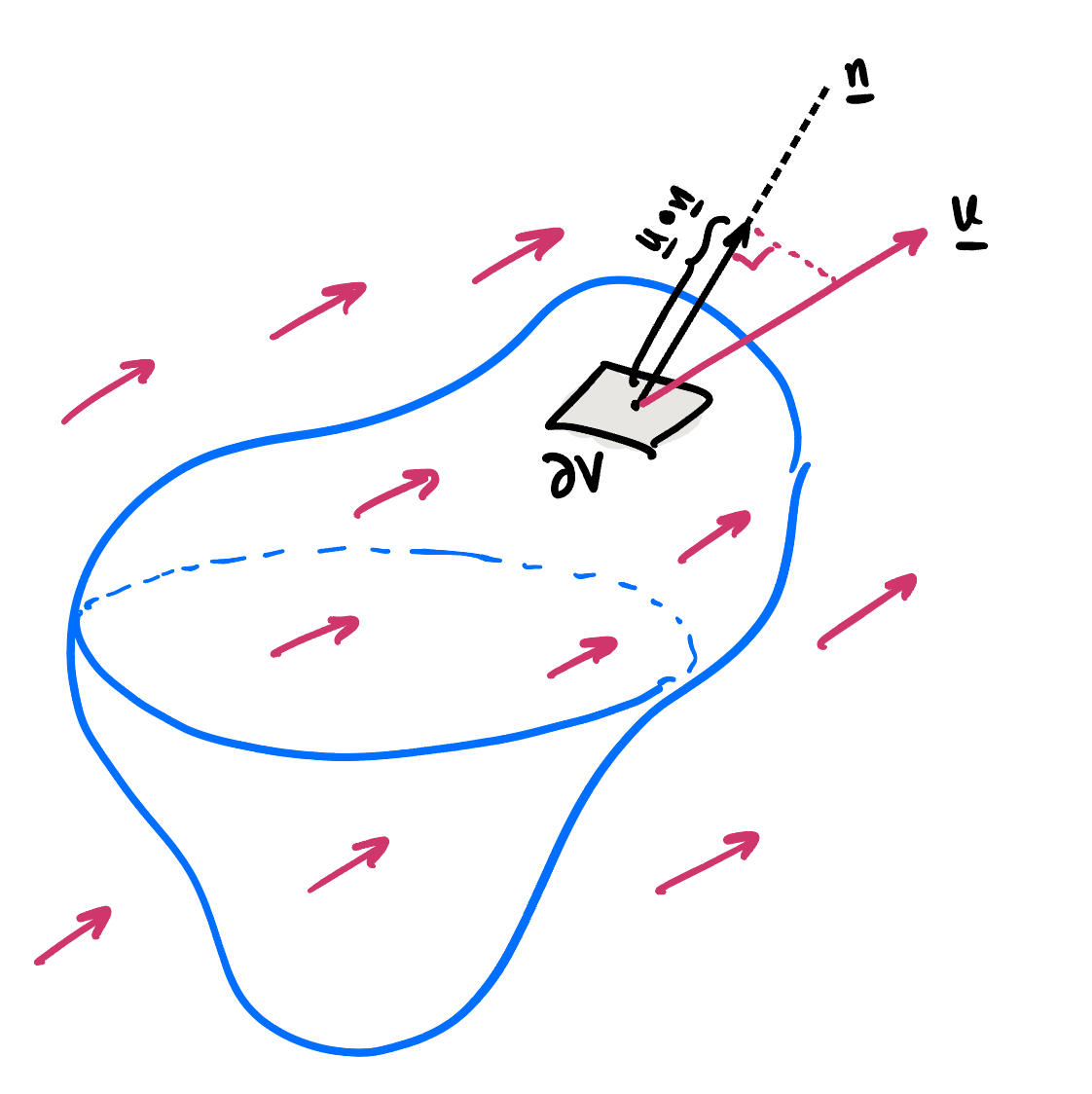
Let the boundary of
\(V\) be given by
\(\partial V\text{,}\) and let
\(\bn\) denote the outward unit normal defined along the boundary
\(\partial V\text{.}\) At each point on the boundary, the volume flow rate per unit area (known as the
flux) across the boundary is given by
\(\bu \cdot \bn\text{,}\) and therefore the mass flow rate per unit area is
\(\rho \bu \cdot \bn\text{.}\)
We now sum the total mass flow across the entire boundary. This is given by the surface integral
\begin{equation*}
\text{rate of mass flow outward across $\partial V$} = \iint_{\partial V} \rho \bu \cdot \bn
\,
\de{S}.
\end{equation*}
The flux out of the boundary is also sketched in
Figure 3.3.
Finally, we apply mass conservation: the rate of change of mass in
\(V\) must equal the rate at which mass flows
inward across
\(\partial V\text{.}\) Since the surface integral above measures the
outward flow, this gives the minus sign in
(3.2.3).