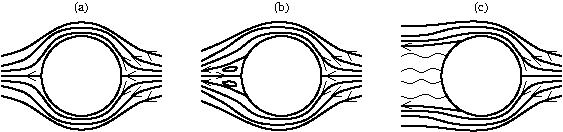
A tethered sphere of radius \(a\) is surrounded by a flowing incompressible Newtonian fluid of density \(\rho\) and shear viscosity \(\mu\text{.}\) In the far field, the fluid velocity is uniform and equal to \(U\) (right to left).
A Newtonian viscous fluid flows steadily in the \(+x\)-direction in two dimensions between plates at \(y=\pm d\text{.}\) You may neglect gravity in this problem.
Find the stress exerted by the fluid on both plates. If each plates has (large) area \(A\text{,}\) what is the \(x\)-component of the tethering force required to keep each plate fixed in place?
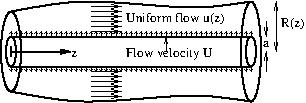
A long cylindrical pipe with slowly varying radius \(R(z)\) is aligned with its axis pointing in the \(z\)-direction. A much narrower cylinder of constant radius \(a\) is placed coaxially within the larger cylinder. The narrow cylinder has porous walls and emits fluid at a constant velocity \(U\) perpendicular to its surface. A fluid flows steadily in the gap between the two cylinders.
Despite the fact that there is flow out from the inner cylinder in the radial direction, you may assume that the flow in the annular gap between the cylinders is unidirectional along the pipe in the \(+z\)-direction. (In reality there will be a thin layer next to the inner cylinder in which this is not true.) Furthermore, you may assume that the flow is uniform across the cross-section, that is \(\bu=(u(z),0,0)\text{.}\)
Consider a narrow slice of the cylinder between \(z\) and \(z+\de z\text{.}\) Find an expression for the volumetric flux of fluid through the surfaces \(z\) and \(z+\de z\text{.}\)
Note that you can actually solve this equation by instead considering the volume between \(z=0\) and \(z=z_0\text{.}\) This volume has four surfaces: the inner cylinder surface \(r=a\text{,}\) the outer cylinder surface \(r=R(z)\text{,}\) and the two cross-sectional surfaces at \(z=0\) and \(z=z_0\text{.}\) The inner cylinder surface gives a volume flux in of \(2\pi aUz_0\text{,}\) the outer cylinder surface gives no volume flux, the surface \(z=0\) gives a volume flux in of \(\pi(R(0)^2-a^2)u(0)\text{,}\) and the surface \(z=z_0\) gives a volume flux out of \(\pi(R(z_0)^2-a^2)u(z_0)\text{.}\) Equating total volume flux in and volume flux out gives
Write down an expression for the Reynolds number of this flow, explaining your reasoning. You may assume that the pipe has length \(L\) and that \(R_0\) is a typical value of \(R(z)\text{.}\) Your answer should be in terms of the problem parameters \(\rho\text{,}\)\(\mu\text{,}\)\(a\text{,}\)\(U\text{,}\)\(L\) and \(R_0\text{.}\)
State in a sentence the conditions under which it might be appropriate to assume that the velocity is uniform across the cross section. You do not need to do a calculation.