**Edits w/c 1 Dec**: we have included some more commentary in the solutions, and are more precise at the start of questions which questions are examinable and which ones are more for deepening your knowledge of the material. Some additional notes have been added into the solutions based on the submitted problem sets of students.
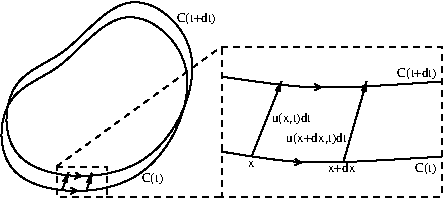
By transforming to Lagrangian variables show that \(\Gamma\) is independent of \(t\text{.}\) Deduce that a flow that is initially irrotational (i.e. \(\bomega = 0\) at \(t=0\)) remains irrotational for all time.
Note that this is a key result: if a flow is initially irrotational, it remains so indefinitely and we can introduce a velocity potential \(\phi\) such that \(\mathbf{u} = \nabla \phi\text{.}\)
We therefore need to write \(\bu\) and \(\de\bx\) at time \(t+\de t\) on the curve \(C(t+\de t)\) to values at time \(t\) on the curve \(C(t)\text{:}\)
The final equality above follows because the line integral of a gradient around a closed curve is zero. Thus \(\Gamma\) is independent of \(t\text{.}\) If the flow is initially irrotational, then \(\Gamma=0\) at \(t=0\) for any closed curve \(C(0)\text{,}\) and hence \(\Gamma=0\) for all time. Since this holds for any closed curve, it follows that \(\omega=\bnabla\times\bu=0\) for all time.
Method two: This can also be proven by parametrising \(C(t)\) via \(\bx(s,t)\) for \(0<s<1\) and rewriting the integral as an integral over the parameter \(s\text{:}\)
\begin{equation*}
\Gamma=\int_0^1\bu(\bx(s,t),t)\cdot\pd{\bx(s,t)}{s}\de s.
\end{equation*}
Given two different such surfaces \(S_1\) and \(S_2\text{,}\) define a `cylindrical’ volume \(V\text{,}\) whose ends are the the two surfaces \(S_1\) and \(S_2\) and whose sides are the sides of the vortex tube, and let \(\Gamma_i = \int_{S_i}\bomega\cdot\bn_i\,\de S\text{,}\) for \(i=1,2\text{.}\)
Given two different such surfaces \(S_1\) and \(S_2\text{,}\) define a `cylindrical’ volume \(V\text{,}\) whose ends are the the two surfaces \(S_1\) and \(S_2\) and whose sides are the sides of the vortex tube, and let \(\Gamma_i = \int_{S_i}\bomega\cdot\bn_i\,\de S\text{,}\) for \(i=1,2\text{.}\)
Consider \(\int_{\partial V}\bomega\cdot\bn\,\de S\text{.}\) This is equal to \(\Gamma_1\) minus \(\Gamma_2\) plus the integral of \(\bomega\cdot\bn\) over the sides of the cylinder. On the sides of the cylinder, we have \(\bomega\cdot\bn=0\text{.}\) Hence, \(\Gamma_1=\Gamma_2\) for any two such surfaces.
(Based on Exercise 5.7 in [4]). In this question, please make use of the vector calculus formulae given in cylindrical polar coordinates, available at this website. Consider an axisymmetric flow. Working in cylindrical polar coordinates \((r,\theta,z)\text{,}\) show that the vorticity is given by
Axisymmetry implies that \(\bu\) has no \(\theta\)-component, that is \(\bu\cdot\be_{\theta}=0\text{,}\) and that \(\partial\bu/\partial\theta=0\text{.}\) Hence, \(\bu=(u_r(r,z,t),0,u_z(r,z,t))\text{.}\)
Axisymmetry implies that \(\bu\) has no \(\theta\)-component, that is \(\bu\cdot\be_{\theta}=0\text{,}\) and that \(\partial\bu/\partial\theta=0\text{.}\) Hence, \(\bu=(u_r(r,z,t),0,u_z(r,z,t))\text{.}\)
We note that \(\partial\be_{\theta}/\partial t=0\) and \((\bu\cdot\nabla)\) has gradients with respect to \(r\) and \(z\) (and not with respect to \(\theta\)), meaning that \((\bu\cdot\nabla)\be_{\theta}=0\text{.}\) Also, since \(\partial\be_r/\partial\theta=\be_\theta\text{,}\)
Two vortices, of strengths \(\Gamma_1\) and \(\Gamma_2\text{,}\) are at the points \(z = z_1\) and \(z = z_2\text{,}\) respectively, in the complex plane. Write down the equations of motion for the position vectors \(z_1(t)\) and \(z_2(t)\) if the vortices are free to move. Assuming that \(\Gamma_1+\Gamma_2\neq0\text{,}\) show that \(\de Z/\de t = \de a/\de t = 0\text{,}\) where
Fluid occupies the region \(x^2+y^2>a^2\) outside a circular obstacle of radius \(a\text{.}\) By using the Milne-Thomson Circle Theorem, find the resulting complex potential when a vortex of strength \(\Gamma\) is placed at \((x, y) = (b, 0)\text{,}\) where \(b > a\) (assuming there to be no circulation about the obstacle).
It is helpful to note that the relationship between instantaneous (linear) velocity, say \(v_\perp\) and angular velocity is \(\Omega = v_\perp/R\) for an object rotating around a circle of radius \(R\text{.}\)
has the same singularities as \(g(z)\) outside the circle \(|z|=R\) and that \(|z|=R\) is a streamline of the flow with complex potential \(w(z)\text{.}\) Removing the line vortex from the associated flow allows its velocity to be found.
separating the logarithms in the final step enables the derivative to be taken more easily. This has a single singularity at the vortex \(z=b\) and the circle \(|z|=a\) is a streamline, as required.
By symmetry, the vortex moves in a circle of radius \(b\) about the origin with speed equal to this value. We thus divide the above by the radius \(b\text{,}\) giving an angular velocity of
Why is angular velocity equal to linear velocity divided by the radius? Consider a particle given by \(z(t) = b\e^{\im\theta(t)}.\) Then \(|\dot{z}| = b \dot{\theta}\text{.}\) Hence \(\dot{\theta}\) (or the angular velocity) is equal to the magnitude of the (linear) velocity divided by \(b\text{.}\)
Fluid occupies the quadrant \(x > 0\text{,}\)\(y > 0\) bounded by two rigid boundaries along the \(x\)- and \(y\)-axes. Find the complex potential for the flow caused by a vortex of strength \(\Gamma\) at a point \(z=c=a+\im b\) in the fluid. If the vortex is free to move, show that it follows a path on which
We use three image vortices at \(x_1-\im y_1\) and at \(-x_1+\im y_1\text{,}\) both of strength \(-\Gamma\text{,}\) and at \(-x_1-\im y_1\) of strength \(\Gamma\text{.}\)
Recall that the complex potential of a line vortex at \(z=c\) of strength \(\Gamma\) is \(-\im\Gamma\log(z-c)/(2\pi)\) and its velocity is given by the derivative of this map: \(u-\im v=-\im\Gamma/(2\pi(z-c))\text{.}\)
Alternative method: We could achieve the same solution using a conformal map. The map
\begin{equation*}
\zeta=z^2
\end{equation*}
transforms the quadrant \(x>0\text{,}\)\(y>0\) to the upper half plane \(\Im\zeta>0\text{.}\) The vortex at \(z=c=a+\im b\) transforms to a vortex at \(\zeta = c^2\) with complex potential
This is equivalent to having vortices of strength \(\Gamma\) at \(z=\pm c\text{,}\) and vortices of strength \(-\Gamma\) at \(z=\pm\overline{c}\text{,}\) which is the same result as above.
Additional note: We could have tried the transformation
\begin{equation*}
\zeta = z^4
\end{equation*}
to map the quadrant to the whole plane. However, we would need to find the solution for a vortex with a half-line (the positive real axis) removed, which is more complicated than the upper half plane.
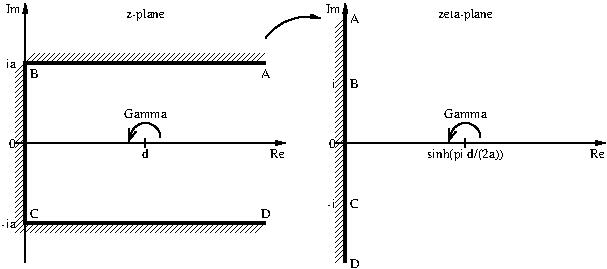
Fluid occupies the semi-infinite channel \(\{z : \Re z > 0,−a < \Im z < a\}\text{.}\) Show that the flow induced by a line vortex of strength \(\Gamma>0\) at the point \(z = d \in\mathbb{R}^+\) has complex potential
and the constraint \(x>0\) corresponds to the line segments above \(+\im\) and below \(-\im\text{,}\) respectively. Hence the channel is transformed to the right half plane:
We have a vortex of strength \(\Gamma\) at the point \(z=d\text{,}\) which point transforms to \(\zeta=\sinh(\pi d/(2a))\text{.}\) In the \(\zeta\)-plane, we also require an image vortex of strength \(-\Gamma\) at the point \(\zeta=-\sinh(\pi d/(2a))\text{.}\) This will ensure that the transformed channel boundary in the \(\zeta\)-plane (i.e. the imaginary axis) has a no-penetration boundary condition.
Using the Helmholtz principle, the vortex moves due to the flow of everything but itself. Thus at \(z=d\text{,}\) excluding the part of the flow due to the vortex, if the vortex flow moves with velocity \((u_V,v_V)\text{,}\) we have