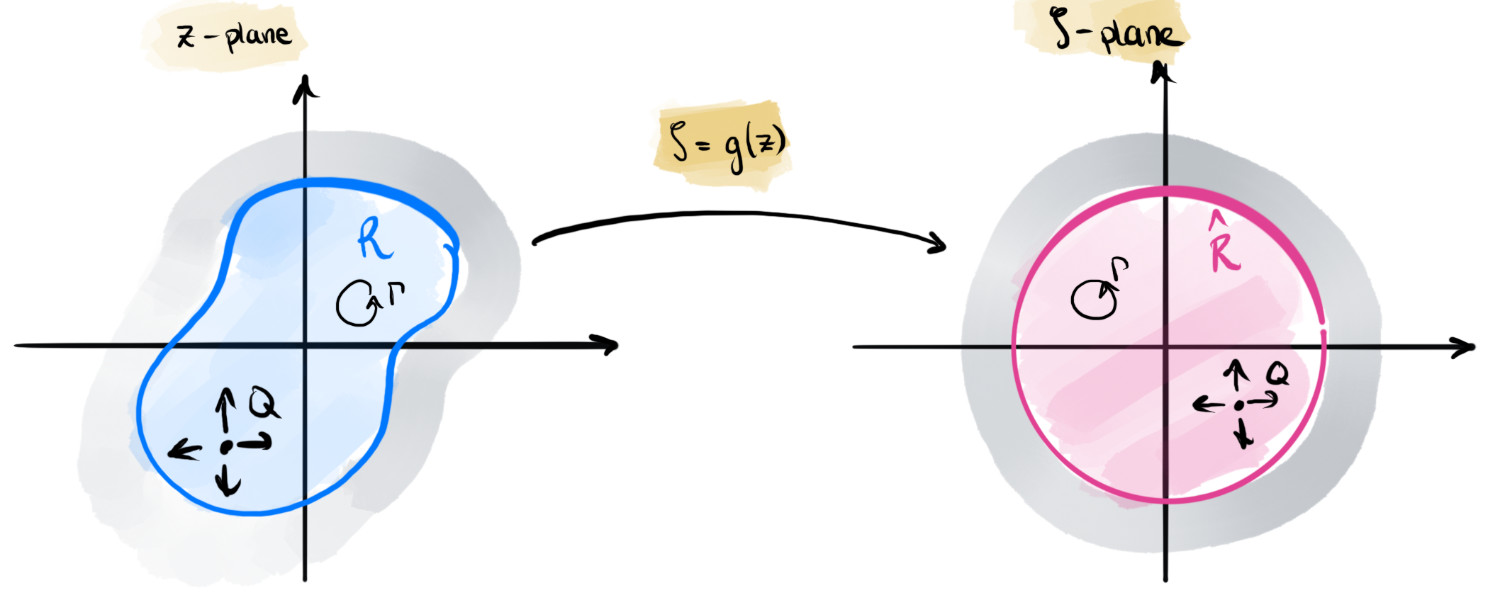
The essential idea of conformal mapping is as follows. Suppose that we are given a two-dimensional potential flow problem in a region, \(R \subseteq \mathbb{C}\text{,}\) with impermeable boundary \(\partial R\text{.}\) There may be singularities in \(R\) corresponding to sinks, sources, vortices, etc. We then seek a conformal mapping from the \(z\)-plane to the \(\zeta\)-plane via
\begin{equation*}
\zeta = g(z),
\end{equation*}
so that the region \(R\) is mapped to a new region \(\hat{R} \subseteq \mathbb{C}\text{,}\) as shown in Figure 4.12.
The hope is that within the \(\zeta\)-plane, the fluid region is sufficiently simple that a complex potential, say \(F(\zeta)\text{,}\) can be found. This is aided by the fact that sources, sinks and vortices are preserved by the map (Proposition 4.5.2). Typically, we wish for \(\hat{R}\) to be e.g. the upper half-plane or the unit disc, and \(\partial\hat{R}\) the real axis or circumference of the unit disc, respectively. Once found, the complex potential in the \(z\)-plane is obtained by composing \(F\) with the map, i.e.
Figure4.12.A general conformal mapping from the \(z\)-plane to the \(\zeta\)-plane. The object is to map the region \(R\) to the region \(\hat{R}\text{,}\) which is geometrically simpler.
The derivative \(g'\) may vanish or be infinite at corners of the boundary (e.g. \(z^{\pi/\alpha}\) at \(z = 0\) in Example 4.5.3), which is how the map straightens corners.
If the boundary \(\partial{\hat{R}}\) is a streamline in the \(\zeta\)-plane, then the corresponding boundary \(\partial R\) is a streamline in the \(z\)-plane (and vice versa).
A source of strength \(Q\) (or vortex of strength \(\Gamma\)) at \(\zeta = g(c) \in \hat{R}\) in the \(\zeta\)-plane corresponds to a source (or vortex) of the same strength at \(z = c \in R\) in the \(z\)-plane (and vice versa).
(1) Near a point \(z_0\text{,}\)\(g(z) - g(z_0) \approx g'(z_0)(z - z_0)\text{,}\) so small line elements are all rotated by \(\arg g'(z_0)\) and scaled by \(|g'(z_0)|\text{;}\) angles between them are unchanged. (2) If \(\Im F\) is constant on \(\partial\hat{R}\text{,}\) then \(\Im f = \Im F(g(z))\) is constant on \(\partial R\text{.}\) (3) Near \(c\text{,}\)\(g(z) - g(c) = g'(c)(z - c)\big(1 + O(z - c)\big)\text{,}\) so \(\log(g(z) - g(c)) = \log(z - c)\) plus a function analytic near \(c\text{.}\)
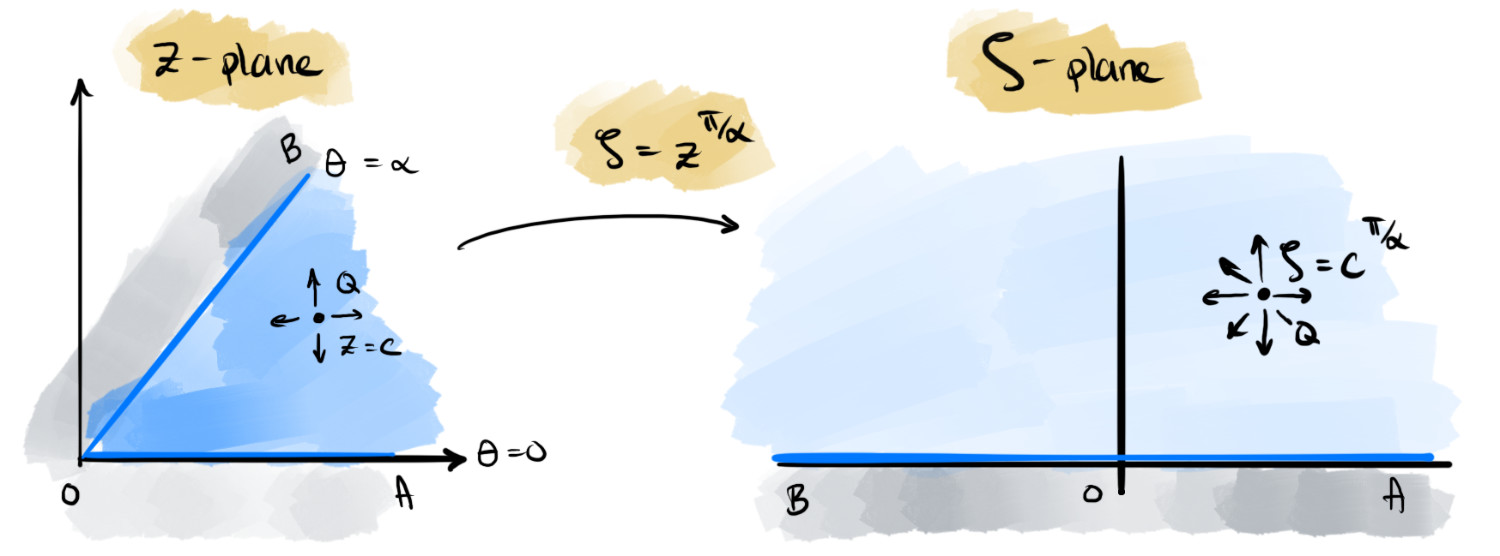
Fluid is contained in a wedge with walls at \(\theta = 0\) and \(\theta = \alpha > 0\text{,}\) with the fluid in \(0 < \theta < \alpha\text{.}\) Find the complex potential of a source of strength \(Q\) at the point \(z = c\) in the wedge.
With \(z = r\e^{\im\theta}\text{,}\) we have \(\zeta = r^{\pi/\alpha}\e^{\im\pi\theta/\alpha}\text{,}\) so \(0 < \theta < \alpha\) is mapped to \(0 < \arg\zeta < \pi\text{,}\) the upper half-\(\zeta\)-plane. The ray \(\theta = 0\) is mapped to the positive real axis and the ray \(\theta = \alpha\) to the negative real axis, as shown in Figure 4.13.
In the \(\zeta\)-plane, we must solve for flow in the upper half-plane with a source of strength \(Q\) at \(\zeta_c = c^{\pi/\alpha}\text{,}\) and an impermeable boundary on the real \(\zeta\)-axis. By the method of images (Section 4.4), we place sources at both \(\zeta_c\) and its complex conjugate, \(\overline{\zeta_c}\text{:}\)
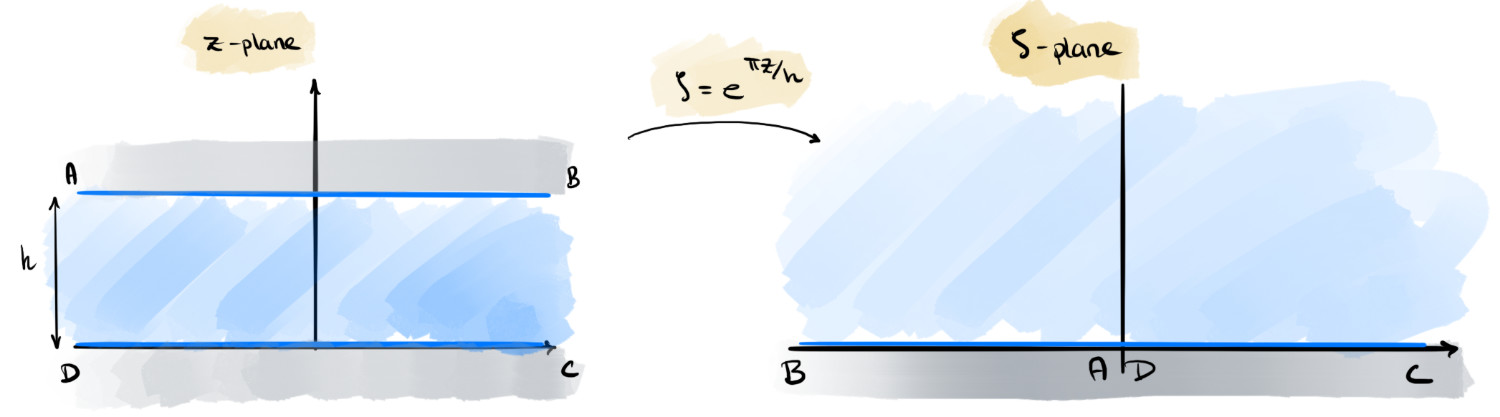
The exponential map is used to map a channel to a half-plane. Consider a channel of width \(h\) in the region \(0 < \Im z < h\) in the \(z\)-plane. Then
maps this channel to the upper half-\(\zeta\)-plane. The correspondence of critical points and points at infinity in the pre-image and the image is shown in Figure 4.14. It is good to see the map as essentially ’unfolding’ the infinite channel, sending points AD to the origin, while sending B to negative infinity and C to positive infinity. The conformal map will preserve the orientation of the boundary, so as we traverse along ABCD, the fluid region is always on the right.
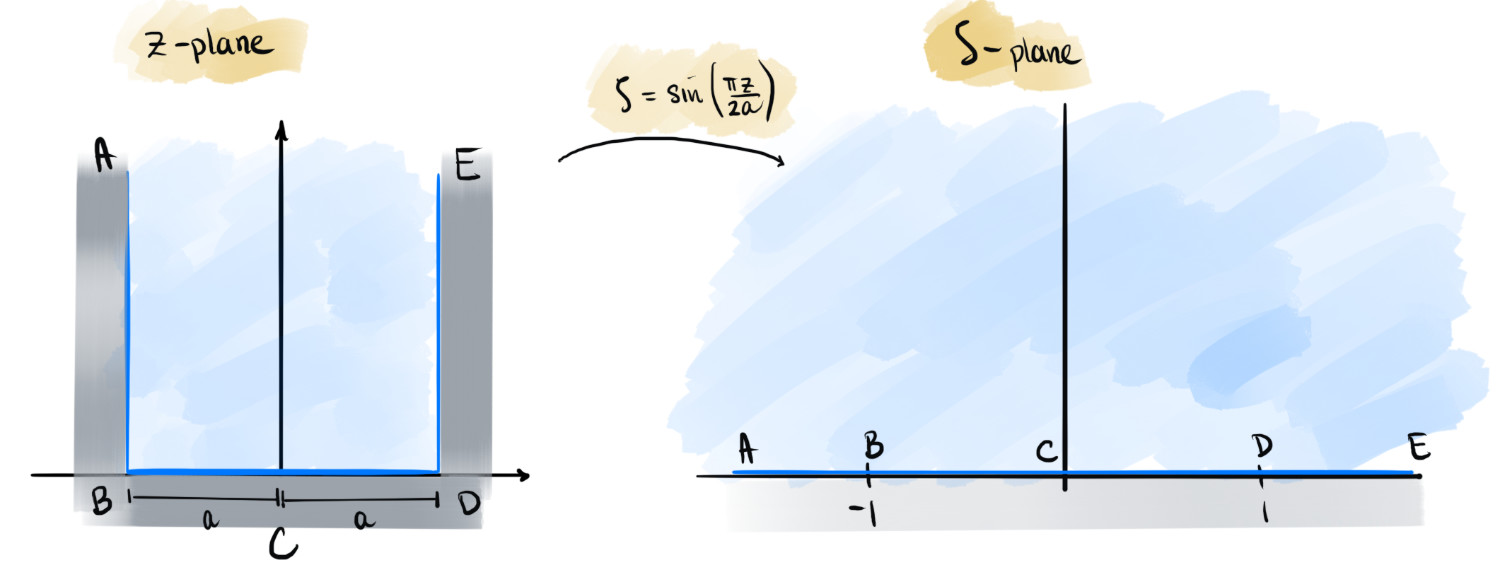
sends the semi-infinite channel of width \(2a\) in Figure 4.15 to the upper half-plane. The two corners at \(z = \pm a\) are mapped to \(\zeta = \pm 1\text{,}\) respectively.
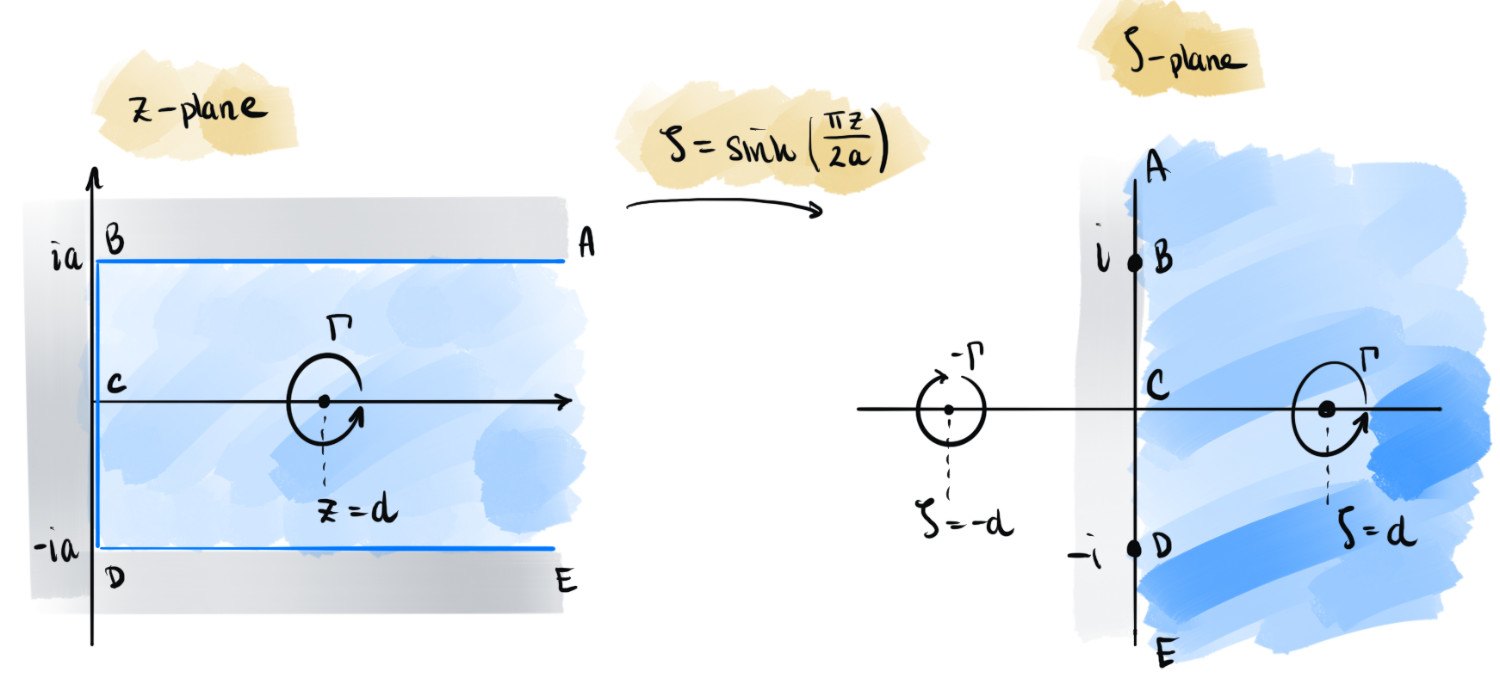
Example4.5.4Vortex flow in a semi-infinite channel.
Consider the channel shown in the left of Figure 4.16. Insert a vortex of strength \(\Gamma\) at the point \(z = d \in \mathbb{R}^+\text{.}\) Verify that an appropriate conformal map is given by
Figure4.16.The sinh transformation maps the semi-infinite channel with height \(2a\) to the right half-plane. (There is a typo in the sketch: the vortex and its image in the \(\zeta\)-plane are at \(\zeta = \pm\sinh(\pi d/2a)\text{,}\) not \(\zeta = \pm d\text{.}\))
The map sends \(z = 0\) and \(z = \pm\im a\) to \(\zeta = 0\) and \(\zeta = \pm\im\text{.}\) On \(x = 0\text{,}\)\(\zeta = \im\sin(\pi y/2a)\) covers the segment between \(\pm\im\text{,}\) and on \(y = \pm a\text{,}\)\(\zeta = \pm\im\cosh(\pi x/2a)\) covers the rest of the imaginary axis. The channel is therefore mapped to the right half-plane, and the vortex to \(\zeta_d = \sinh(\pi d/2a) \gt 0\text{.}\)