The preceding sections may give the misleading impression that solving potential-flow problems for two-dimensional flows is easy. This is not the case, and the primary reason is the presence of boundary conditions. The elementary flows we have previously considered were unconfined and/or we did not consider additional constraints on their behaviours at infinity. In reality, a real physical fluid, whether in the ocean, the air, or in a container, is confined in some direction, and we must often consider subtle questions about the mechanism that produces the fluid motion.
In this section, we consider the situation of solving for the potential flow in a fluid region with boundaries. Recall that this is equivalent to finding a velocity potential satisfying \(\nabla^2 \phi = 0\) or an analytic complex potential, \(f(z)\text{.}\)
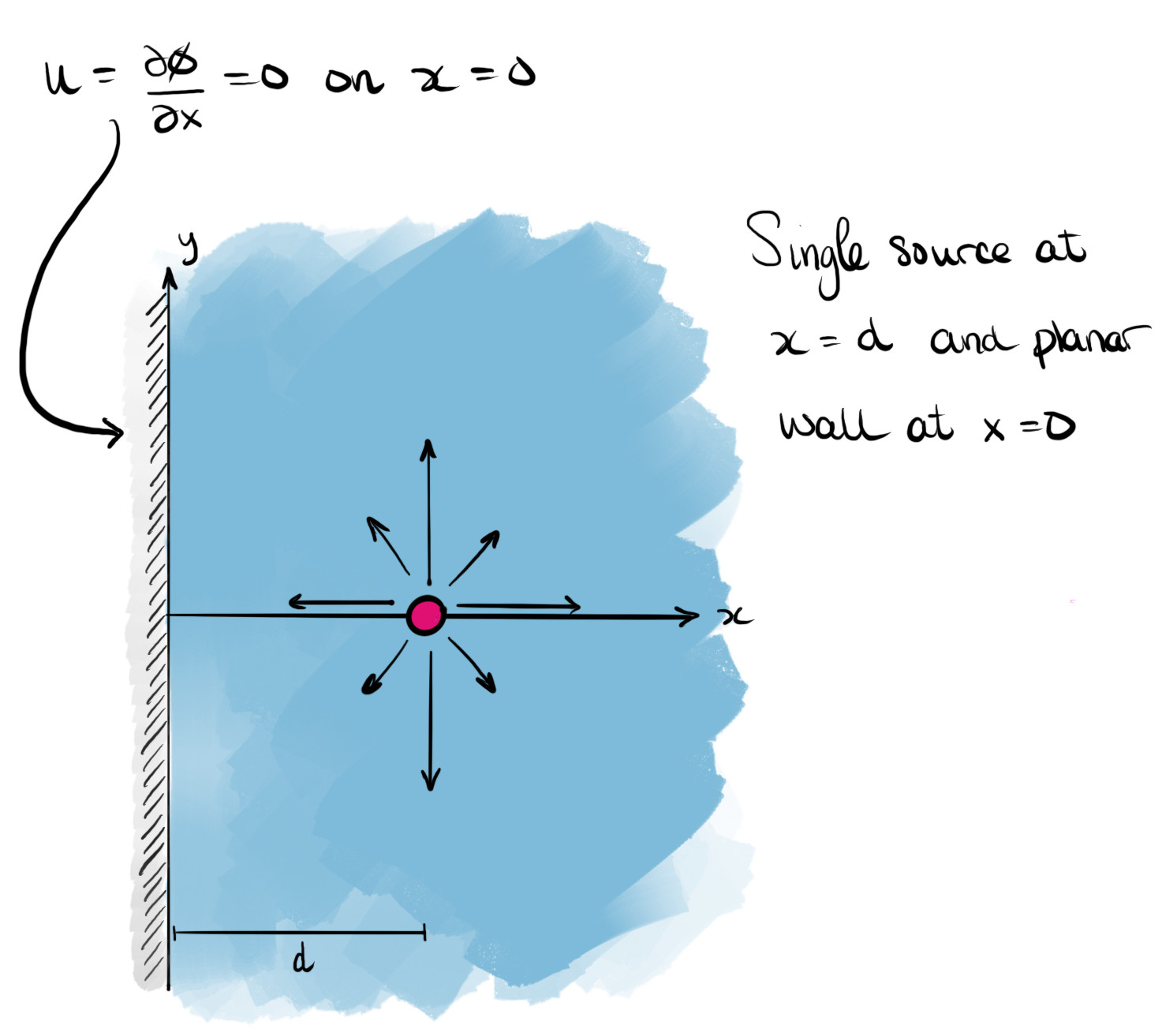
We envision a semi-infinite region of fluid bounded on the left by a wall at \(x = 0\text{.}\) A single (line) source of strength \(Q\) is placed at \(x = d\text{.}\) Therefore from (4.3.5), we would expect that at least near \(x = d\text{,}\) the complex potential behaves as
However, the above potential does not satisfy the required boundary condition at \(x = 0\text{,}\) since its horizontal velocity penetrates through \(x = 0\text{.}\) This can be checked by inspecting the velocity or the streamlines (see Exercise 4.7.4).
The strengths and locations of the individual contributions are chosen so that boundary conditions on the required boundaries (including at infinity) can be met.
Notice that the linearity of the potential flow problem is crucial: any analytic function is associated with a velocity potential that satisfies Laplace’s equation, \(\nabla^2 \phi = 0\text{,}\) and therefore the superposition of such functions also yields a permissible complex potential, \(f\text{.}\)
Find the complex potential of a line source of strength \(Q\) at \(z = d\) in the half-plane \(x \gt 0\text{,}\) bounded by a wall at \(x = 0\text{,}\) and verify the no-flux condition on the wall.
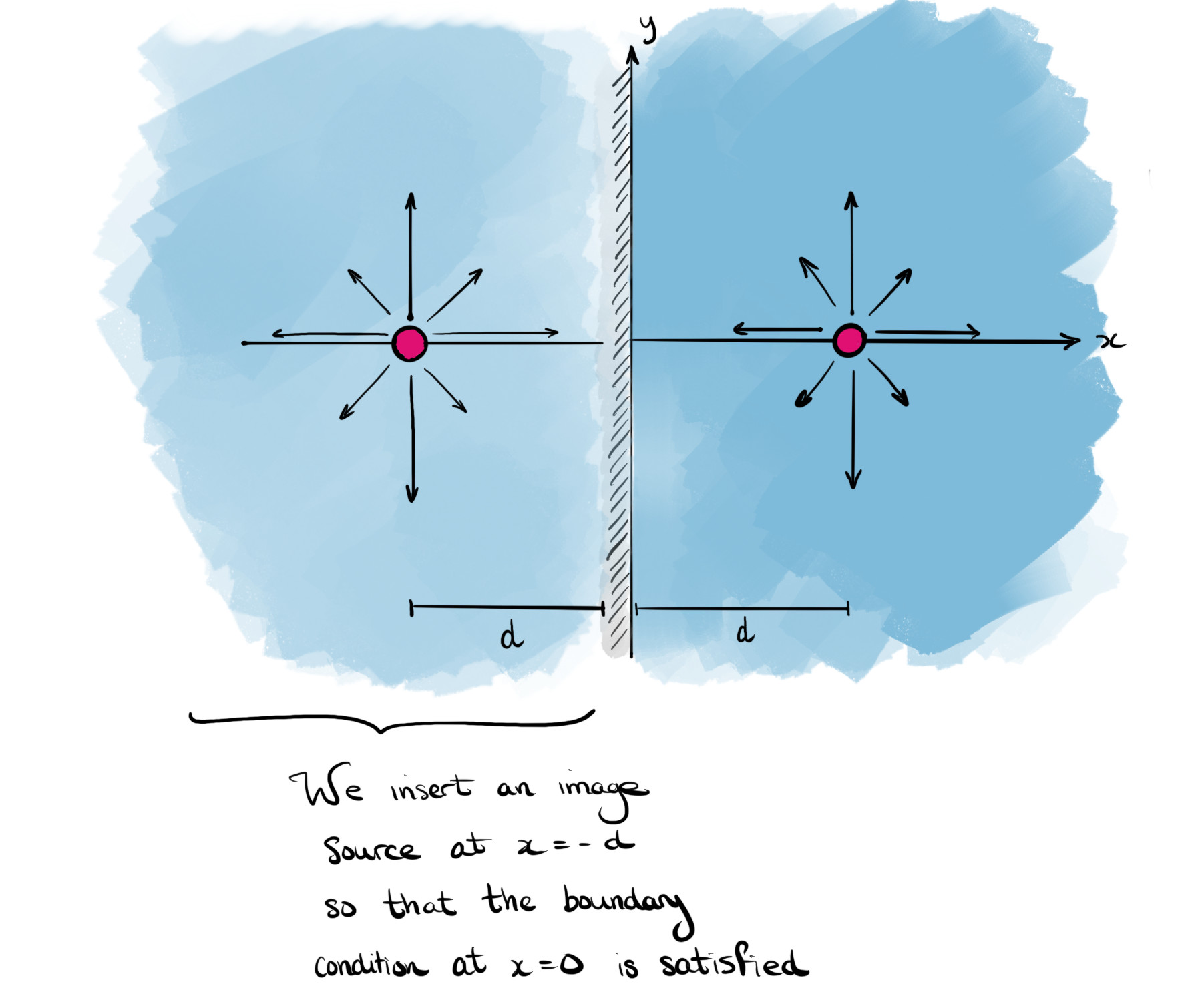
We add a "fictitious" image source of the same strength at the reflected point \(z = -d\text{,}\) which lies outside the fluid region. This gives the complex potential
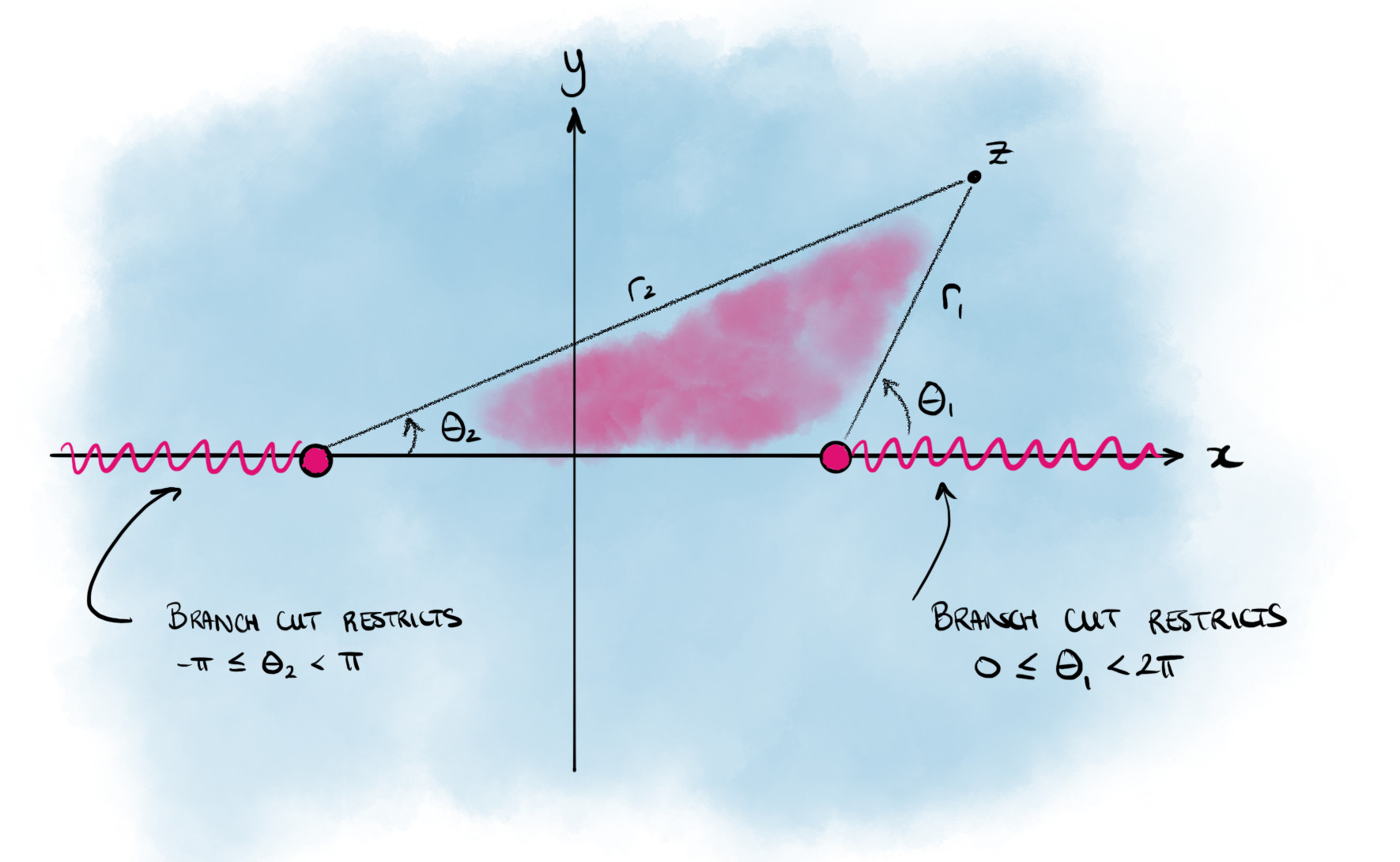
To develop an equation for the streamlines, we must first navigate the fact that the complex logarithm is only well-defined in a slit complex plane. Let
\begin{equation*}
z - d = r_1 \e^{\im \theta_1} \quad \textrm{and} \quad z + d = r_2 \e^{\im \theta_2},
\end{equation*}
For each logarithm to be well defined, the angles must be restricted to an interval of length \(2\pi\text{.}\) We thus restrict \(\theta_1 \in [0, 2\pi)\) and \(\theta_2 \in [-\pi, \pi)\text{.}\)
Figure4.11.When considering the evaluation of the flow, we must take care of the fact that the logarithm is multi-valued. A branch cut from each of the two branch points is imposed.
Find the complex potential of a line vortex of strength \(\Gamma\) at \(z = d\) in the half-plane \(x \gt 0\text{,}\) bounded by a wall at \(x = 0\text{,}\) and verify the no-flux condition on the wall.
Near \(z = d\text{,}\) we expect \(f(z) \sim -\frac{\im\Gamma}{2\pi} \log(z - d)\text{,}\) but this potential alone does not satisfy the no-flux condition at \(x = 0\text{.}\) We add an image vortex at \(z = -d\) of opposite sign:
For \(\Gamma \gt 0\text{,}\) this flow is composed of a line vortex circulating anticlockwise on the right, and a line vortex circulating clockwise on the left. The complex velocity is
\begin{equation*}
u - \im v = -\frac{\im \Gamma d}{\pi(z^2 - d^2)},
\end{equation*}
and on \(z = \im y\text{,}\)\(u - \im v = \im\Gamma d/[\pi(y^2 + d^2)]\text{,}\) so \(u = 0\) and there is no flux through the wall.
You may be wondering whether a potential found by the method of images, with its ’fictitious’ image points, is the only solution. It is unique (up to a constant) once we prescribe the singularities in the flow region (sources and vortices, with their strengths), the no-flux condition on the walls, and the behaviour at infinity, e.g. \(\bu \to \mathbf{0}\text{.}\) This follows from the uniqueness of solutions to Laplace’s equation with this type of boundary condition (a Neumann problem).
The condition at infinity matters. In the examples above, adding a uniform flow parallel to the wall, \(f = -\im Uz\) (for which \(\psi = -Ux\) is constant on \(x = 0\)), still satisfies the no-flux condition, but changes the flow far from the source or vortex.