If you would like feedback on your work, the tutor will by default concentrate on the exercises highlighted with a yellow background in the online notes (the homework exercises), unless you specifically ask for feedback on a different exercise instead.
This chapter focused on deriving the conservation laws for a fluid from first principles using vector calculus, leading to the Euler equations for an inviscid and incompressible flow. We then studied different forms of the Euler equations and their consequences.
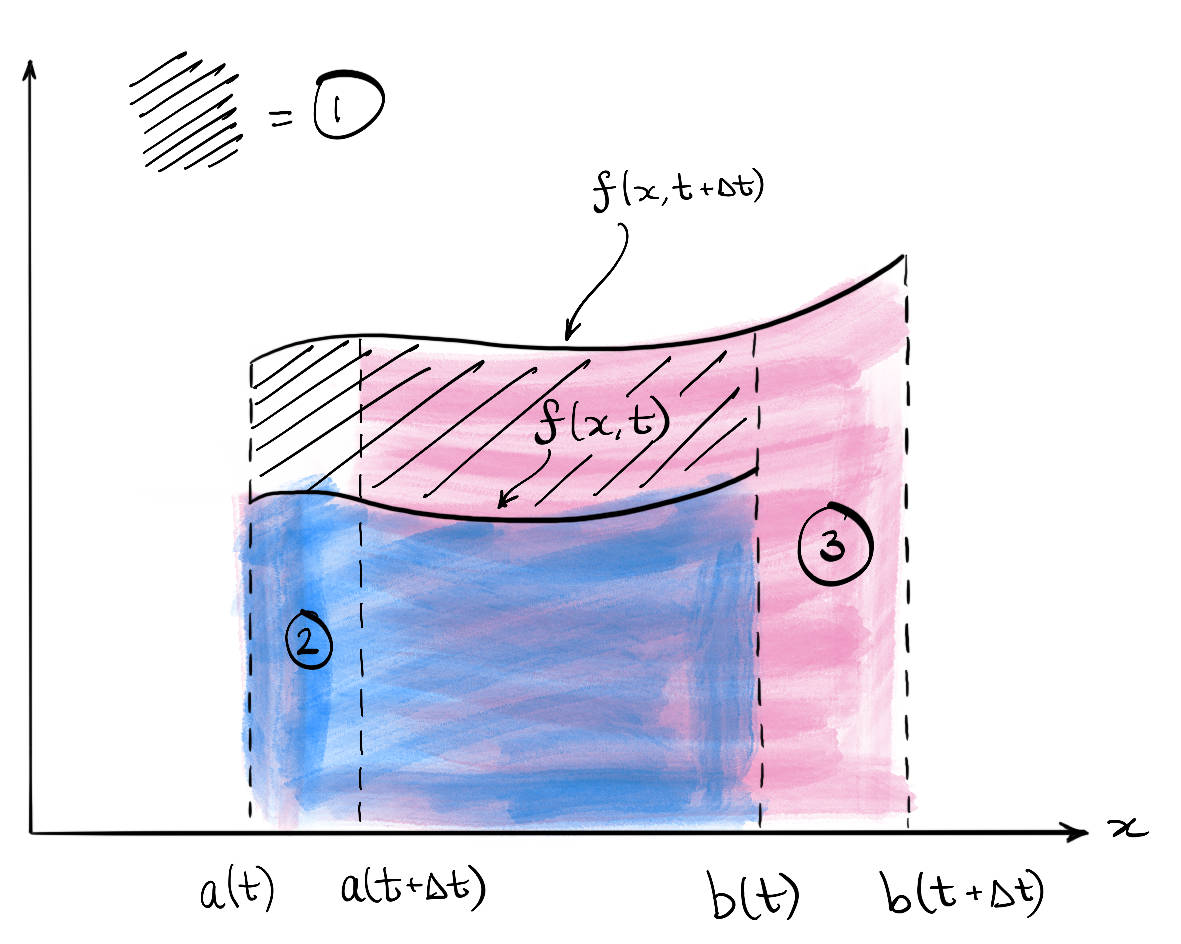
Reynolds’ Transport Theorem Theorem 3.1.3, which relates to the passage of a time derivative through an integral, is a general form of the 1D Leibniz rule:
Write \(I(t + \Delta t)\) as an integral from \(a(t + \Delta t)\) to \(b(t
+ \Delta t)\text{,}\) and split it into three integrals: one over the fixed interval \([a(t),
b(t)]\text{,}\) and one over each of the two small intervals near the end points. These correspond to the three circled regions in Figure 3.5. For small \(\Delta
t\text{,}\) the two small intervals are narrow, so each of their integrals can be approximated by the area of a single rectangle.
A fully rigorous proof is not required here. It is fine to use approximations such as these, provided you explain why they become exact as \(\Delta t \to 0\text{.}\)
Starting from conservation of mass and momentum for a material volume moving in an inviscid fluid, use Reynolds’ Transport Theorem (3.1.2) to derive the equations:
What additional assumptions are required to transform the set of equations to the Euler equations of Definition 3.4.5? Apply these assumptions and conclude with the Euler equations.
An inviscid, incompressible fluid of constant density \(\rho\text{,}\) in a gravitational field with acceleration vector \(\bg = -g \bk\) (with \(\bk\) being the unit vector in the positive \(z\)-direction) has uniform velocity
\begin{equation*}
\bu = (a + b t, \; t^3, \; \e^t).
\end{equation*}
The pressure at the origin is fixed at \(p_0\text{.}\)
The piston shown in the diagram below is pushed with a force \(F(t)\) into a pipe of length \(L\) and cross-sectional area \(A\) containing incompressible and irrotational fluid of density \(\rho\text{.}\)
Using the Euler equations in Definition 3.4.5, write down a differential equation governing the position, \(X(t)\text{,}\) of the piston at time \(t\text{.}\) You may neglect gravity. You do not need to solve the equation (it could be solved using Python or similar).
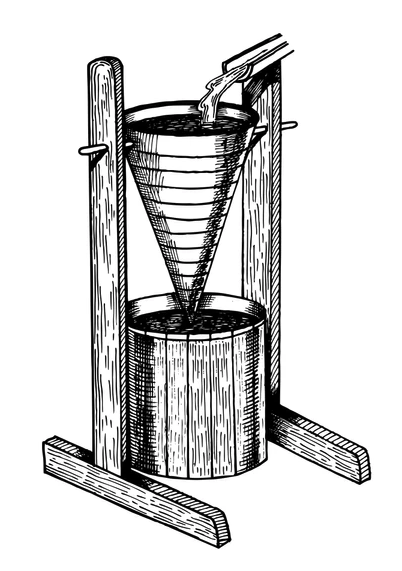
One of the earliest means for measuring the passage of time, invented by the ancient Egyptians, was the clepsydra (or ‘water thief’): a large jar with a hole in its base was filled with water. The shape of the jar was such that the interval of time taken for the water surface to pass two equally-spaced markers on the side of the jar is constant.
In this question you will determine the shape of jar required to achieve this. In particular, we denote the radius of the (axisymmetric) jar at height \(z\) above the hole by \(r = a(z)\text{.}\) Note that, in general, the radius of the hole, \(a_h\text{,}\) differs from \(a(0)\text{.}\)
If the surface of the water lies at \(z = h(t)\text{,}\) use an appropriate form of Bernoulli’s principle to calculate the speed of liquid, \(u\text{,}\) leaving the jar at \(z
= 0\text{.}\)
[You may assume that the desired surface speed \(u_S = |\dot{h}| \ll u\text{,}\) so that the flow is approximately steady and that the fluid pressure is atmospheric at \(z = 0\text{.}\)]
Use the principle of conservation of mass to link \(u_S\text{,}\)\(u\text{,}\)\(a_h\) and \(a(h(t))\text{;}\) thereby determine the correct shape for a clepsydra.
This exercise completes Example 3.1.5. Consider the steady velocity field \(\bu = \left(x, \; -\tfrac12 y, \; 0\right)\text{,}\) and let \(V(t)\) be the material volume that initially occupies the unit cube \(V(0) =
[0,1]^3\text{.}\) From the example, \(V(t) = [0, \, \e^{t}] \times [0, \, \e^{-t/2}] \times
[0, \, 1]\) and the Jacobian is \(J = \e^{t/2}\text{.}\) Let
\begin{equation*}
f(\bx) = x^2 + y, \qquad I(t) = \iiint_{V(t)} f \, \de{x} \, \de{y} \, \de{z}.
\end{equation*}
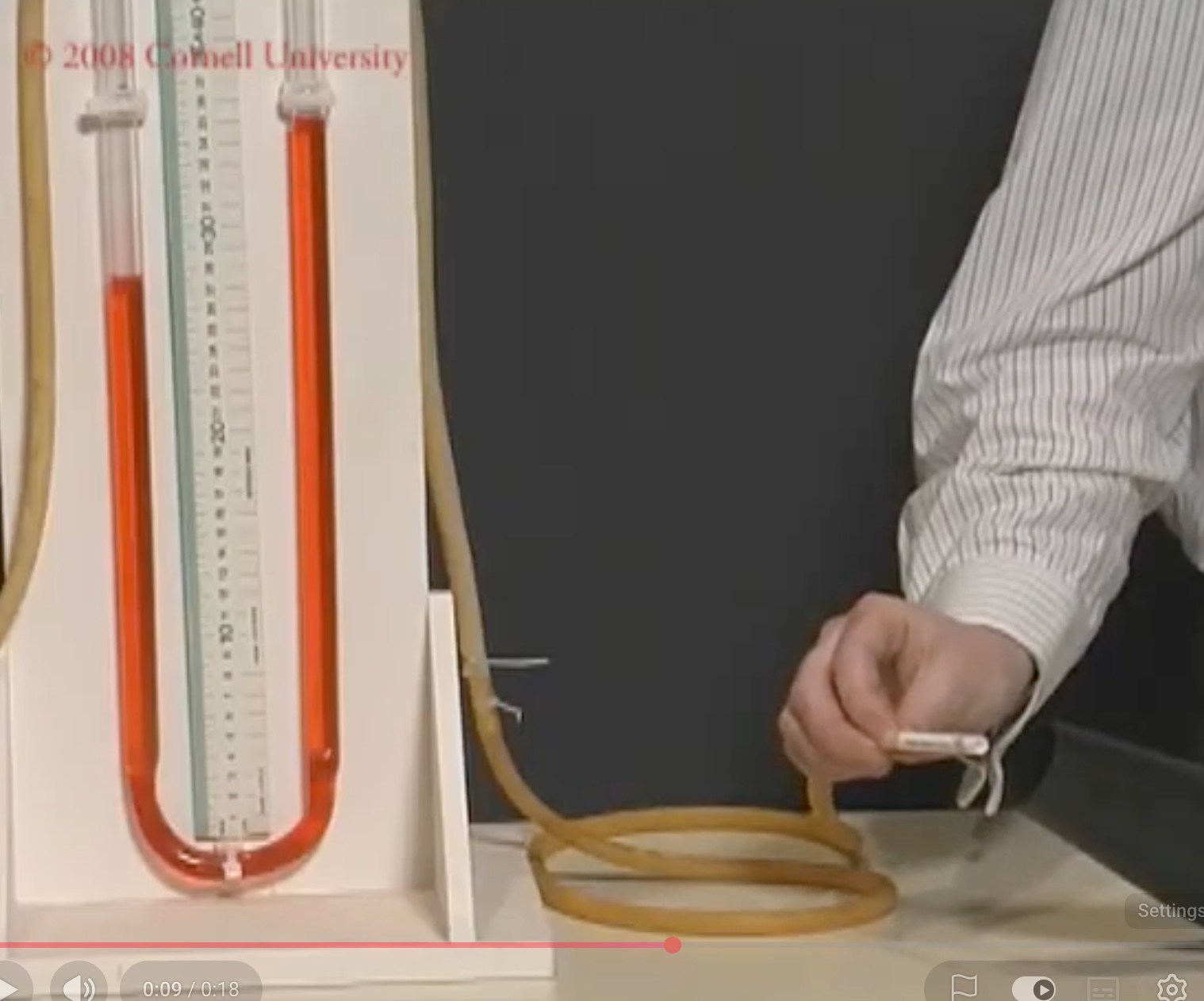
Aircraft measure their airspeed using a Pitot tube: a thin tube that points forwards into the oncoming air, with its open tip facing the flow. The pressure inside the tube is compared with the pressure of the surrounding air. In the simplest version of the device, shown below, this comparison is made with a U-tube of water (a manometer). One arm of the U-tube is connected to the Pitot tube, and the other arm is open to the surrounding air.
Suppose that air of constant density \(\rho_\text{air}\) approaches the tip of the tube with uniform speed \(U\) and pressure \(p_\infty\text{.}\) The flow is steady, and the air entering the tube pushes the water down in the arm connected to the tube and up in the open arm. Measured from the same reference level, let the water surface be at height \(h_1\) in the arm connected to the tube and at height \(h_2\) in the open arm, so that the height difference is \(\Delta h = h_2 - h_1 \gt 0\text{.}\) The water has density \(\rho_w\text{.}\)
Explain why the air is brought to rest at the open tip of the tube. Hence, use an appropriate form of Bernoulli’s equation to show that the pressure at the tip is
Follow the streamline that ends at the tip of the tube, where the air is brought to rest. Then treat the water in the U-tube as a fluid at rest, as in Example 3.5.12.
The air inside the tube is at rest, so the pressure \(p_0\) is transmitted to the water in one arm of the U-tube. The other arm is open to air at pressure \(p_\infty\text{.}\) Neglecting the weight of the air in the tubes, show that
\begin{equation*}
p_0 - p_\infty = \rho_w g \Delta h.
\end{equation*}
\begin{equation*}
U = \sqrt{\frac{2 \rho_w g \Delta h}{\rho_\text{air}}}.
\end{equation*}
Evaluate \(U\) when the water levels are at \(h_1 = 0.25\) m and \(h_2 =
0.75\) m, taking \(\rho_\text{air} = 1\,\text{kg/m}^3\text{,}\)\(\rho_w = 1000\,\text{kg/m}^3\text{,}\) and \(g = 10\,\text{m/s}^2\text{.}\)