Further, we know that if the flow is irrotational, then there exists a velocity potential, \(\phi\text{,}\) such that \(\bu = \nabla \phi\text{.}\) Thus the velocities are expressed as
\begin{equation}
u = \pd{\phi}{x} \quad \textrm{and} \quad v = \pd{\phi}{y}.\tag{4.1.3}
\end{equation}
The above result about irrotational flows is a standard result in Vector Calculus, but we will re-state the result here for reference, and provide a review of its proof.
Consider a three-dimensional time-dependent velocity field, \(\bu = \bu(\bx, t)\) defined on a simply connected domain \(\bx\in D \subset \mathbb{R}^3\text{.}\)
Then \(\bu\) is irrotational, i.e. \(\nabla \times \bu = \mathbf{0}\text{,}\) if and only if there exists a scalar potential \(\phi\text{,}\) defined on \(D \times \mathbb{R}^+\text{,}\) such that \(\bu = \nabla \phi\text{.}\)
where \(C\) is any contour connecting an arbitrary origin point to the point \(\bx\) (changing the origin point will change the "constant" of integration \(\phi_0(t)\)).
We can verify, using the definition of differentiation, and the fundamental theorem of calculus, applied along each of the three coordinate directions, that \(\nabla \phi = \bu\) as desired.
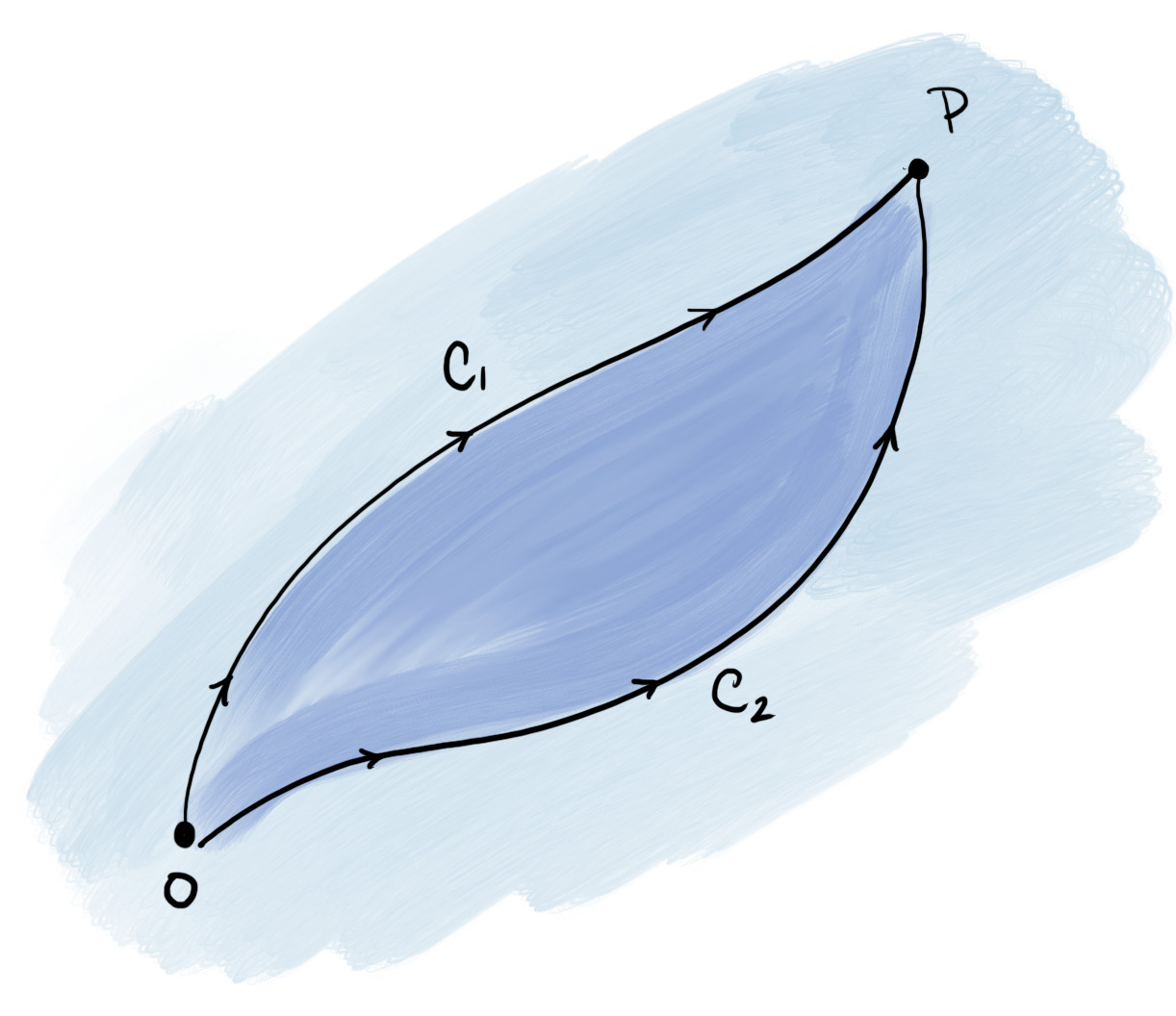
The key is to prove that the above definition is independent of the choice of contour \(C\text{.}\) To this end, consider two contours, \(C_1\) and \(C_2\text{,}\) both with the same origin point, \(O\text{,}\) and end point \(P\text{.}\) Then the contour \(C_1 - C_2\) is a closed contour beginning and ending at \(O\text{.}\)
where \(S\) is any surface with bounding curve \(C_1 - C_2\) (such a surface lying in \(D\) exists because \(D\) is simply connected), and with unit normal \(\bn\) positively oriented with the bounding curve. However, the right-hand side is zero by irrotationality, and therefore
within the flow region. This is effectively a single linear equation for the single unknown \(\phi\text{.}\) However, for different problems, the boundary conditions can render even this "simple" problem difficult.
Once the velocity potential \(\phi\) has been found, the velocities in the flow can be recovered from the relationship (4.1.3). The pressure in the flow also follows from Bernoulli’s equation. For the situation of a steady potential flow, following Theorem 3.5.8, it is
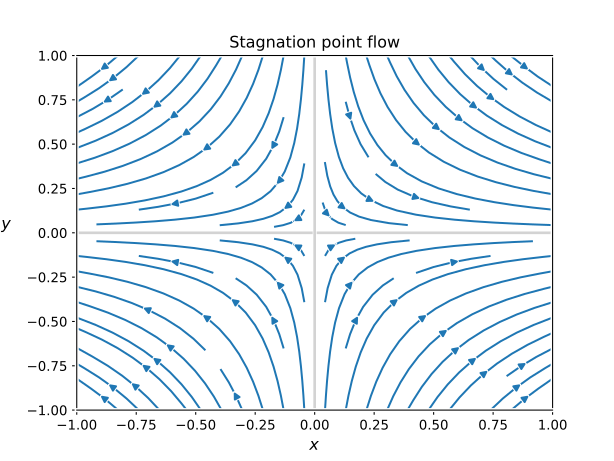
The next three examples will introduce you to the elementary flows consisting of uniform flow, stagnation point flow, and line source/sink flows. You will also investigate the notion of a source "strength".
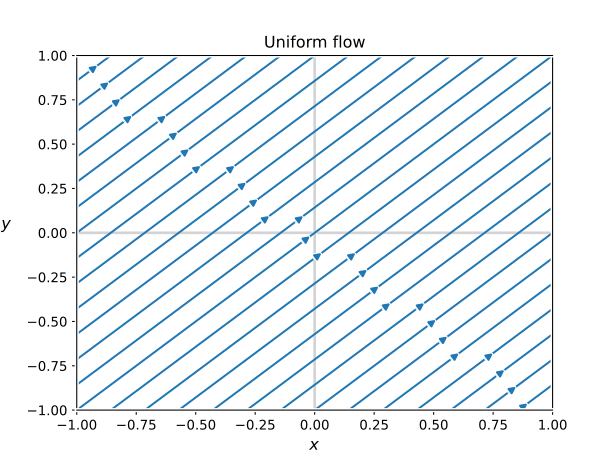
The velocity is constant, \(\bu = U[\cos\alpha, \sin\alpha]\text{.}\) Integrating \(\pd{\phi}{x} = U\cos\alpha\) and \(\pd{\phi}{y} = U\sin\alpha\) gives, up to a constant, the linear function
\begin{equation*}
\phi(x, y) = Ux \cos\alpha + Uy \sin\alpha,
\end{equation*}
which clearly satisfies \(\nabla^2\phi = 0\text{.}\) The streamlines are shown below.
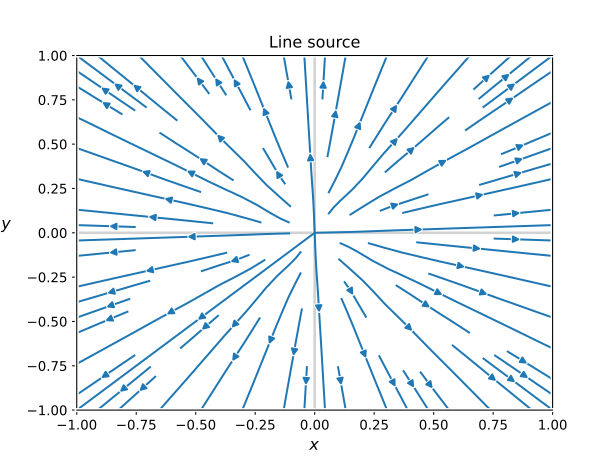
A line source ejects fluid from the origin equally in all directions. Find a radially symmetric potential \(\phi = \phi(r)\) satisfying Laplace’s equation, and the corresponding velocity \(\bu\text{.}\) By computing the flux of fluid across a circle centred at the origin, relate the constant in \(\phi\) to the rate \(Q\) at which fluid is produced.
using \(\be_r = [\cos\theta, \sin\theta]\text{.}\) The flow is directed radially outwards. It is called a "line" source because in \((x, y, z)\) the source runs parallel to the \(z\)-axis.
The flux (the flow per unit time) of fluid crossing a closed contour \(C\) with unit normal \(\bn\) is \(\int_C \bu \cdot \bn \, \de{s}\text{.}\) Take \(C\) to be the circle \(r = a\text{,}\) on which \(\bn = \be_r\) and the arc-length element is \(\de{s} = a \, \de\theta\text{.}\) Then
Therefore, \(Q\text{,}\) the strength of the source, is the rate at which fluid is produced. If \(Q \lt 0\text{,}\) we refer to the flow as a line sink.
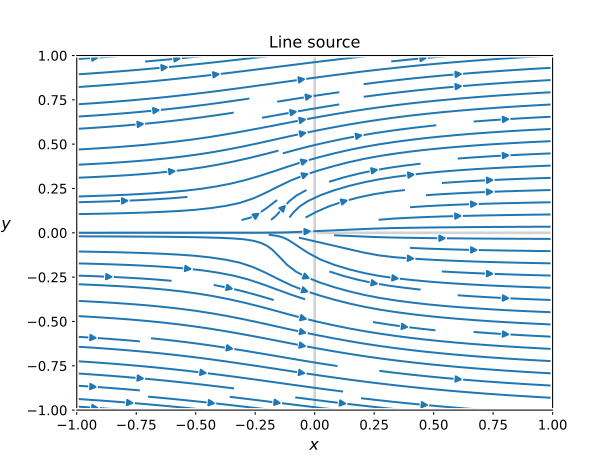
Find the velocity potential \(\phi\) and the velocity \(\bu\) of a line source of strength \(Q\) at the origin placed in a uniform flow of speed \(U\) in the \(x\)-direction.