Skip to main content
Contents Index
Search Book
Search Results:
No results.
Read aloud Readability settings Prev Up Next \(\renewcommand*{\Re}{\operatorname{Re}}
\renewcommand*{\Im}{\operatorname{Im}}
\newcommand{\e}{\mathrm{e}}
\newcommand{\im}{\mathrm{i}}
\newcommand{\de}{\mathrm{d}}
\newcommand{\dd}[2]{\frac{\de#1}{\de#2}}
\newcommand{\DD}[2]{\frac{\mathrm{D}#1}{\mathrm{D}#2}}
\newcommand{\pd}[2]{\frac{\partial#1}{\partial#2}}
\newcommand{\pD}[2]{\dfrac{\partial#1}{\partial#2}}
\newcommand{\pdd}[2]{\frac{\partial^2\!#1}{\partial#2^2}}
\newcommand{\dxyz}{\de{x}\de{y}\de{z}}
\newcommand{\dXYZ}{\de{X}\de{Y}\de{Z}}
\newcommand{\bx}{\boldsymbol{x}}
\newcommand{\bs}{\boldsymbol{s}}
\newcommand{\be}{\boldsymbol{e}}
\newcommand{\bX}{\boldsymbol{X}}
\newcommand{\bn}{\boldsymbol{n}}
\newcommand{\bt}{\boldsymbol{t}}
\newcommand{\bu}{\boldsymbol{u}}
\newcommand{\bv}{\boldsymbol{v}}
\newcommand{\ba}{\boldsymbol{a}}
\renewcommand{\bf}{\boldsymbol{f}}
\newcommand{\bg}{\boldsymbol{g}}
\newcommand{\bF}{\boldsymbol{F}}
\newcommand{\bomega}{\boldsymbol{\omega}}
\newcommand{\bOmega}{\boldsymbol{\Omega}}
\newcommand{\bsigma}{\boldsymbol{\sigma}}
\newcommand{\btau}{\boldsymbol{\tau}}
\newcommand{\bd}{\boldsymbol{d}}
\newcommand{\bI}{\boldsymbol{I}}
\newcommand{\bi}{\boldsymbol{i}}
\newcommand{\bj}{\boldsymbol{j}}
\newcommand{\bk}{\boldsymbol{k}}
\newcommand{\br}{\boldsymbol{r}}
\renewcommand{\bt}{\boldsymbol{t}}
\newcommand{\btheta}{\boldsymbol{\theta}}
\newcommand{\bphi}{\boldsymbol{\phi}}
\newcommand{\bz}{\boldsymbol{z}}
\newcommand{\bq}{\boldsymbol{q}}
\newcommand{\bzero}{\boldsymbol{0}}
\newcommand{\bnabla}{\boldsymbol{\nabla}}
\DeclareGraphicsRule{.gif}{png}{.png}{}
\newcommand{\lt}{<}
\newcommand{\gt}{>}
\newcommand{\amp}{&}
\definecolor{fillinmathshade}{gray}{0.9}
\newcommand{\fillinmath}[1]{\mathchoice{\colorbox{fillinmathshade}{$\displaystyle \phantom{\,#1\,}$}}{\colorbox{fillinmathshade}{$\textstyle \phantom{\,#1\,}$}}{\colorbox{fillinmathshade}{$\scriptstyle \phantom{\,#1\,}$}}{\colorbox{fillinmathshade}{$\scriptscriptstyle\phantom{\,#1\,}$}}}
\)
Section 1.1 A reminder of vector calculus
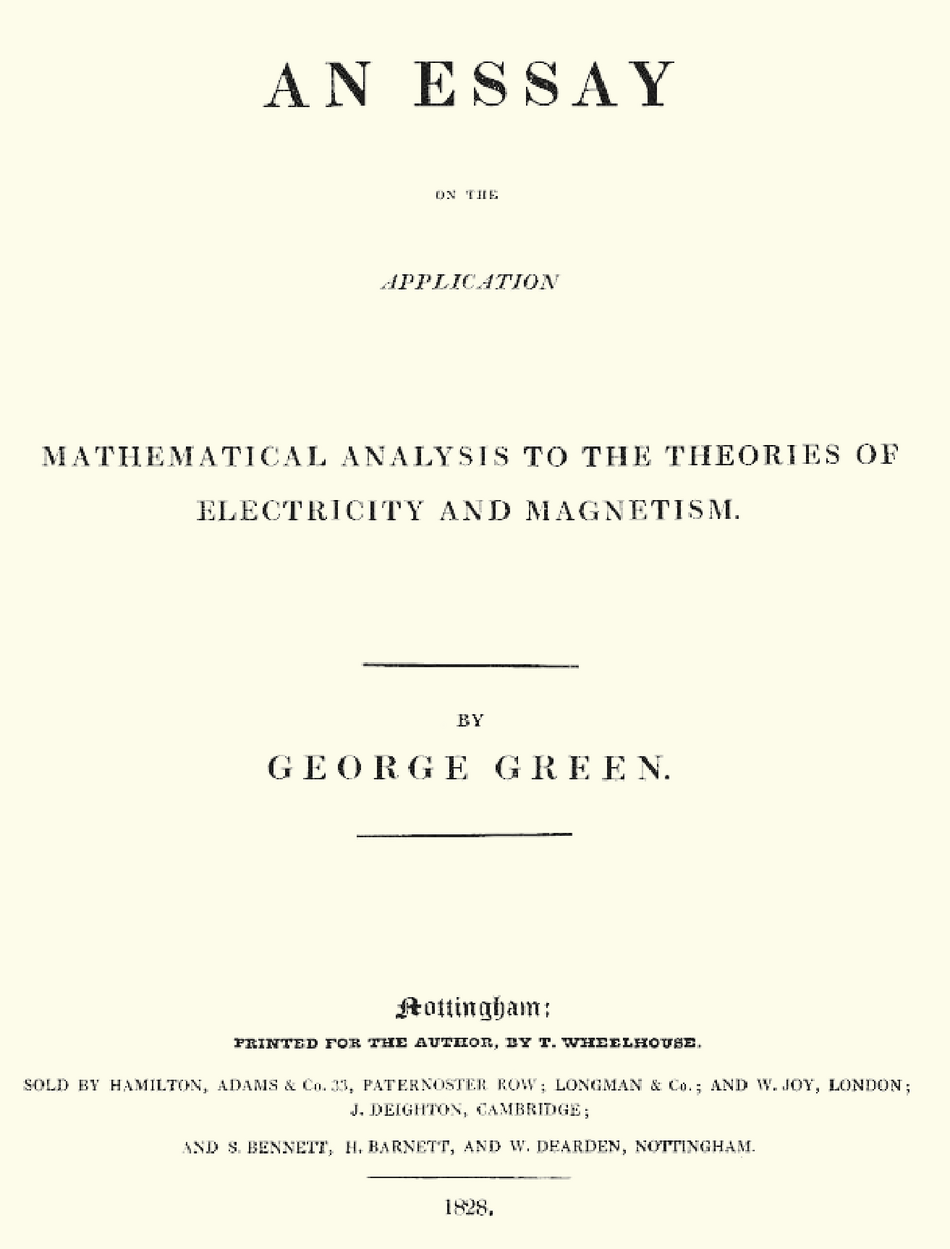
Figure 1.5. George Green’s monumental work on electricity and magnetism, making use of many new concepts in vector calculus, 1828.
During the first week, we will provide a very brief review of some of the necessities that you may require in terms of vector calculus. Many of you will have taken the MA20223 Vector Calculus and Partial Differential Equations module, and a version of the 2026-27 lecture notes has been updated for easy reference
on Moodle .
We will assume that you are familiar enough with how to interpret many of the vector calculus identities found in Sec. 10 of the University of Bath book of tables, which can be accessed on Moodle or
via this link .
In general, over the next few weeks, you will want to be familiar with recalling/looking up concepts like:
The use of identities like
\(\bnabla\cdot(\bnabla\times \mathbf{A}) = 0\) and
\(\bnabla\times(\bnabla\phi) = 0\text{.}\) Some of these are found on p.24 of the above tables.
The notion of line integrals, surface integrals, and volume integrals.
The divergence theorem and Stokes’ theorem. (p.24)
Conversion of vector operations and integrals into different coordinate systems (p.25)