Section 1.2 A reminder of complex variables
In Chapter 4, we will leverage the power of complex variables to study certain problems in fluids (flow of a potential flow). This section is not necessary to read at this stage, but you might find it useful to refresh your knowledge of basic identities for complex-valued quantities.
Subsection 1.2.1 Basic complex representations
Generally, we write the Cartesian and polar form of a complex number as,
\begin{equation*}
z = x + \im y = r\e^{\im\theta},
\end{equation*}
for magnitude \(r > 0\) and angle \(\theta\text{.}\) Below, we will consistently refer to \(z\in\mathbb{C}\text{.}\) The decomposition of the complex exponential is given by Euler’s identity:
\begin{equation}
\e^{\im\theta} = \cos \theta + \im \sin\theta.\tag{1.2.1}
\end{equation}
The usual trigonometric functions can be extended to the complex plane by considering their definition in terms of complex exponentials and Euler’s identity. For example, we have
\begin{equation}
\cos z = \frac{\e^{\im z} + \e^{-\im z}}{2} \quad \text{and} \quad \sin z = \frac{\e^{\im
z} - \e^{-\im z}}{2\im}.\tag{1.2.2}
\end{equation}
Another important function we shall consider is the complex logarithm, defined as
\begin{equation}
\log z \equiv \log r + \im \theta,\tag{1.2.3}
\end{equation}
where \(z = r\e^{\im\theta}\text{.}\) That this definition is sensible is verified by checking that the logarithm is the inverse of the exponential. That is,
\begin{equation*}
\e^{\log z} = \e^{\log r + \im\theta} = \e^{\log r} \e^{\im\theta} = z.
\end{equation*}
Note that the definition (1.2.3) is troubling because it is not single-valued. For example, writing \(z = 1 \e^{\im \cdot 0}\) and \(z = 1 \e^{\im
\cdot 2\pi}\) gives two different possible values of \(\log z\) for the same value of \(z
= 1\text{.}\) In order to restrict the logarithm to a well-defined single-valued function, we typically establish what is called a branch cut -- this restricts the evaluation of the function from encircling the origin more than once.
For example, it is common to define the complex logarithm with the branch cut either along the negative real axis or the positive real axis.
Subsection 1.2.2 Complex functions
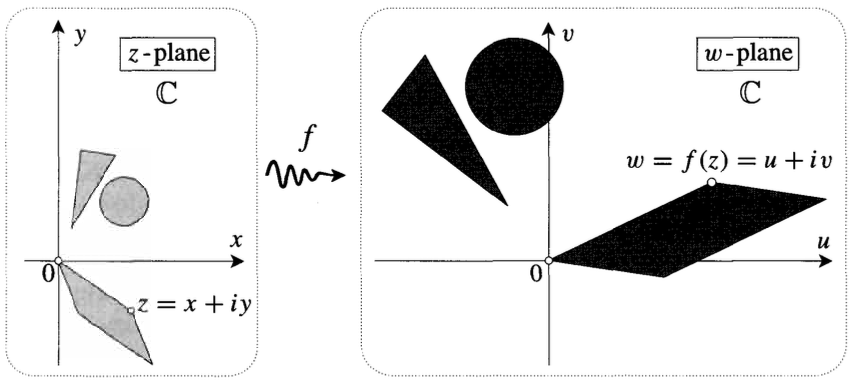
A complex function maps points on the complex plane to points on the complex plane. For instance, the square function,
\begin{equation*}
f(z) = z^2 = r^2 \e^{2\im \theta},
\end{equation*}
can be better understood by its effect on points on the unit circle, \(|z| = 1\text{.}\)
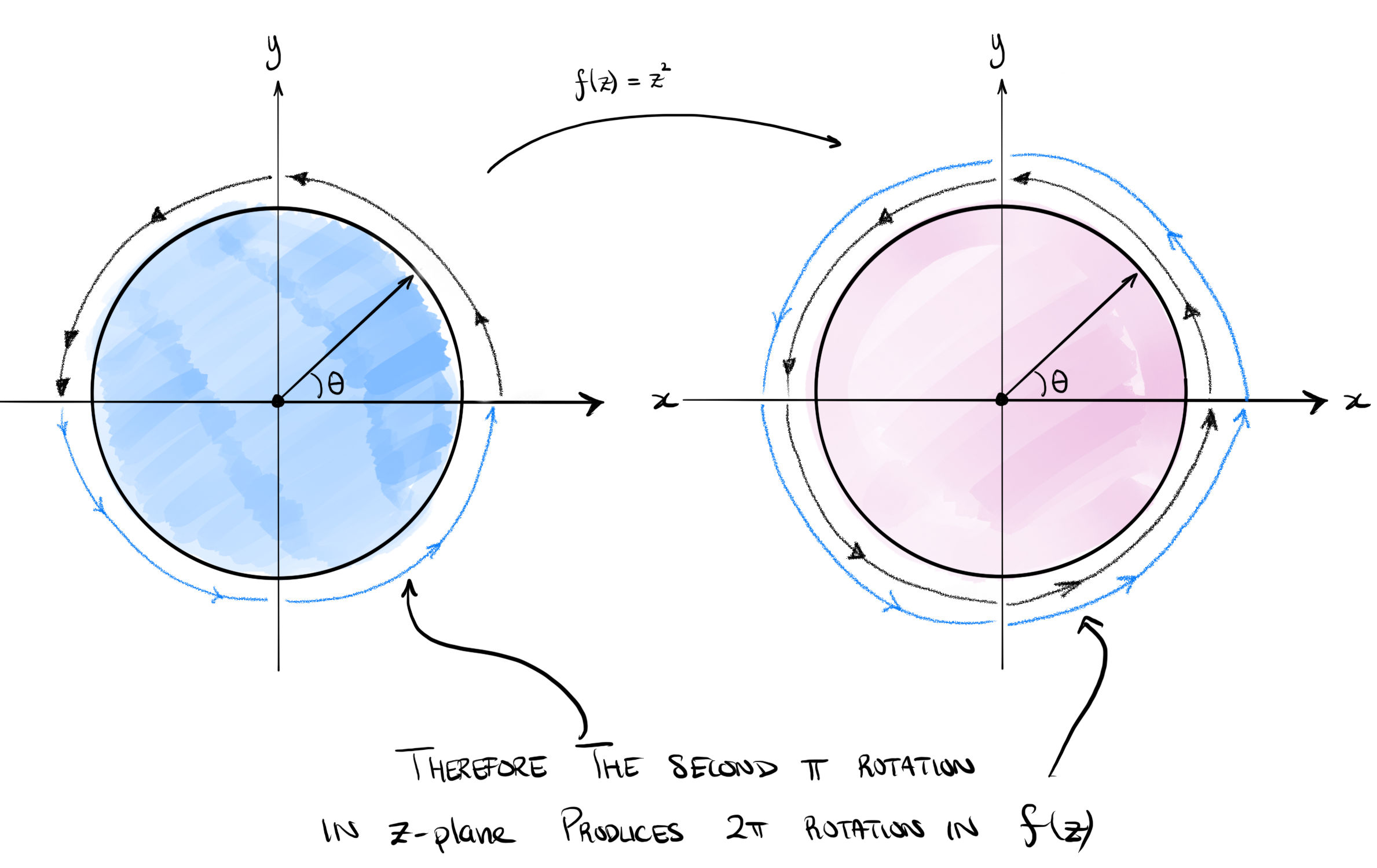
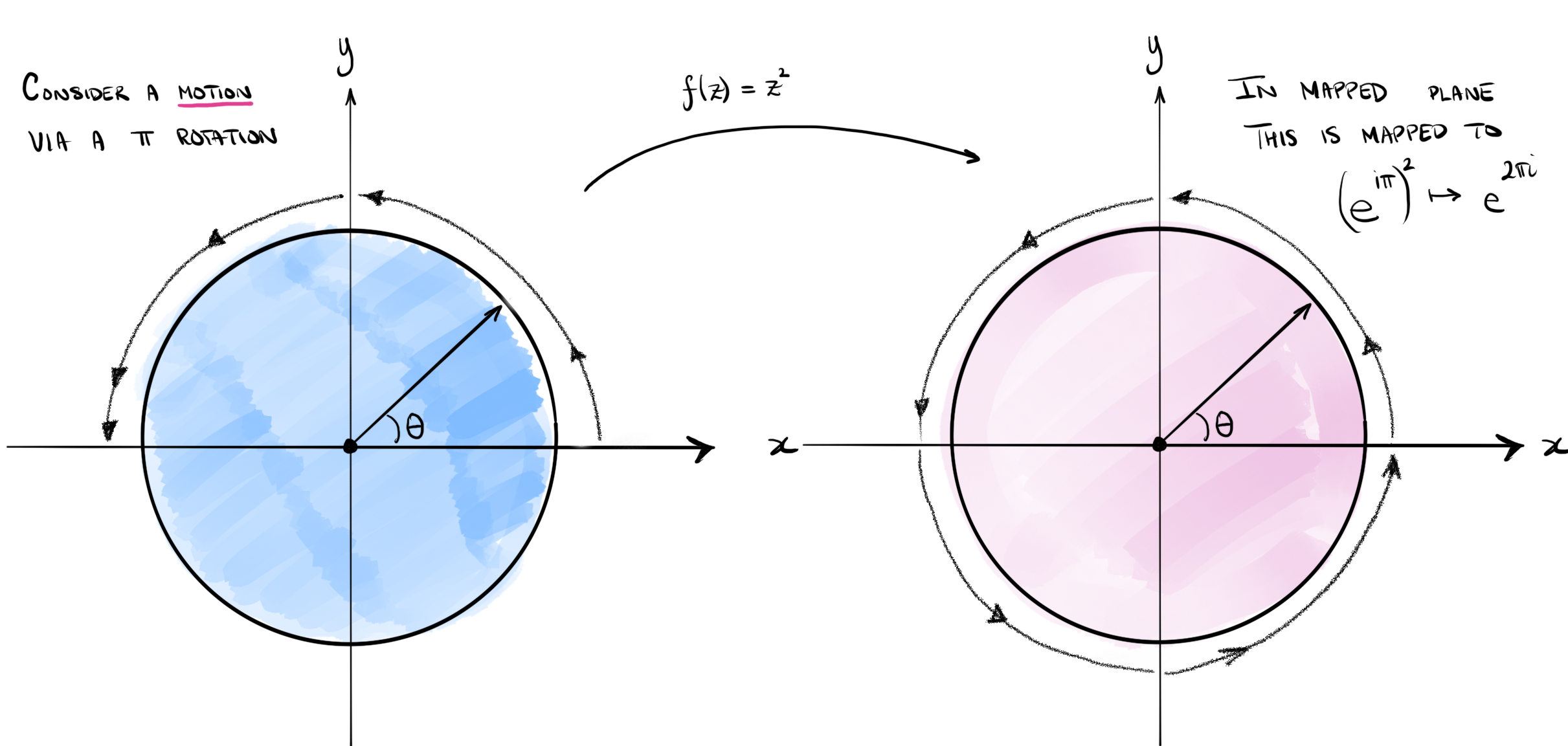
Consider a particle that orbits around the unit circle in the \(z-\)plane at unit speed. If the particle rotates by half a revolution, with \(\theta = \pi\text{,}\) then in the image plane, the image particle has rotated by a full revolution, with \(f(z) = (\e^{\im
\pi})^2\) in this same unit time. This is illustrated by the image in Figure 1.7.
Now we continue rotating around the unit circle in the \(z-\)plane, performing an additional \(\pi\) rotation. Within the image plane, the particle has now completed another full rotation around the unit circle. This is shown in Figure 1.8.