There are different ways to visualise the dynamics of a fluid. Given the velocity, \(\bu(\bx,
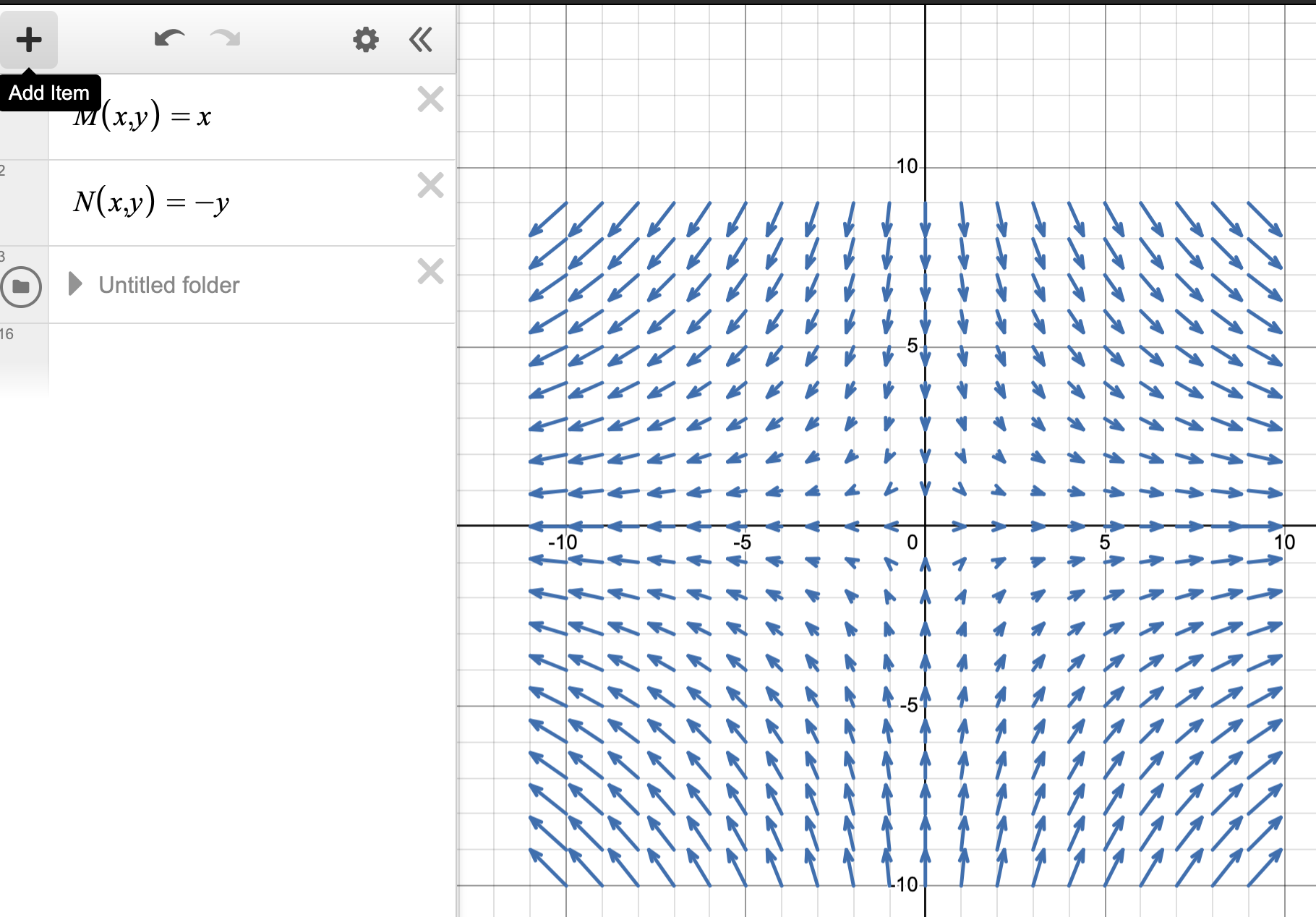
t)\text{,}\) we can plot a vector field at each point in space, and at a fixed moment in time. Little arrows are used to indicate the direction and the length of the arrow can be chosen to represent the magnitude. Joining these up at a fixed moment in time into smooth curves gives the streamlines of the flow. This is often the easiest type of visualisation to perform mathematically, but the hardest experimentally.
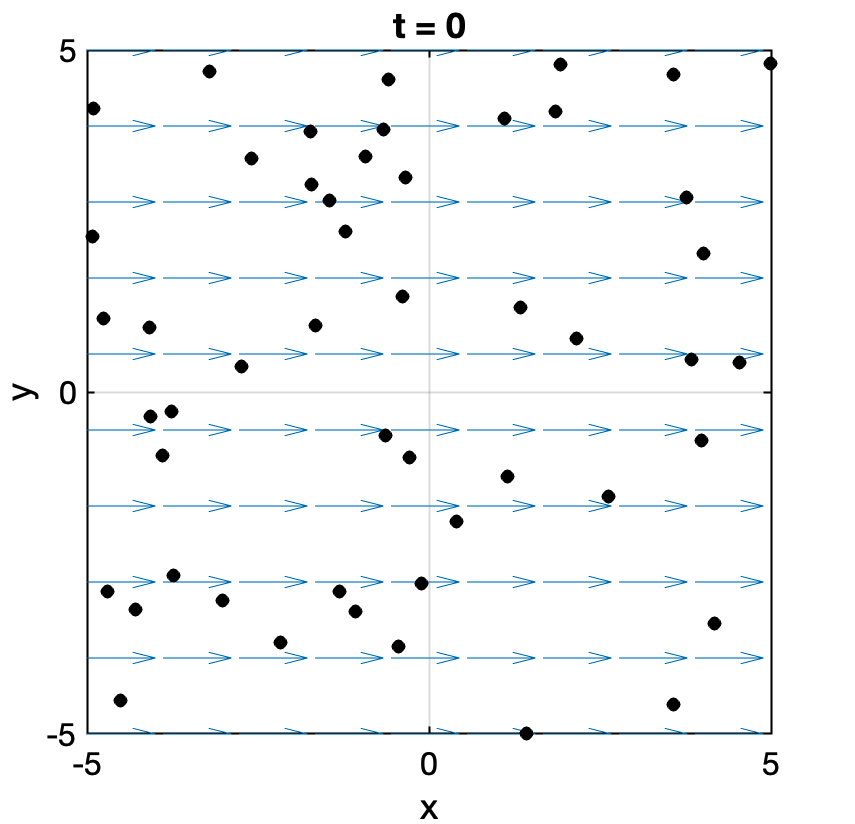
Another representation of the flow is using particle paths or pathlines. Given a point and time, the particle path is the trajectory that would result if a particle were dropped into the flow at that chosen point and time. It is thus found by solving an equation where at every point on the trajectory, the particle’s velocity is the specified velocity of the fluid.
A third representation is a streakline. If dye were continuously released into a fluid from a fixed chosen point, the streakline at a given time is the line that would be made by the dye. It is thus found by finding the current position of those particles whose pathline has visited the chosen point at any past time. This is often the easiest type of visualisation to perform experimentally, but the hardest to perform mathematically.
Note that in a steady flow, the streamlines, pathlines and streaklines all coincide. However, in an unsteady flow, they are all different. In Exercise 2.3.1 you will study a video showing this concept.
where \(s\) is a parameter along the streamline. Choosing a variety of different initial points, \(\bx_1\text{,}\) and solving the above equation gives a family of streamlines at time \(t_1\text{.}\)
The pathline or particle path from an initial point is what we would physically expect if we were to dye the point with a colour and follow the dye colour as time increases.
for a variety of values of \(t_3\text{.}\) This gives the current position of all particles that have passed through the point \(\bx_3\) at any time \(t_3\) in the past.
There are many online applications, such as this one that will allow you plot a two-dimensional direction field. It is also good to do it yourself by hand.
\begin{equation*}
x(t) = A + \sin t, \quad y(t) = B - \cos t, \quad z(t) = C,
\end{equation*}
for constants \(A, B, C\text{.}\) Therefore, we see that the particle paths are closed circles (in the \(xy\)-plane) of unit radius encircling the point \((A, B, 0)\text{.}\)
In this case, considering the streakline via Definition 2.2.3, we conclude that the streakline coincides with the particle path. Can you reason why this must be the case in this situation? What is necessary in order for this not to be true?
which integrates to \(x = \frac{u_0}{\omega}\cos\big(\omega(t - y/v_0)\big) +
C\text{.}\) Requiring the streamline to pass through the origin gives
\begin{equation*}
x = \frac{u_0}{\omega}\Big[\cos\big(\omega(t - y/v_0)\big) - \cos(\omega t)\Big].
\end{equation*}
At \(t = 0\) this is \(x = \frac{u_0}{\omega}\big[\cos(\omega y/v_0) -
1\big]\text{,}\) and at \(t = \pi/(2\omega)\) it is \(x = \frac{u_0}{\omega}\sin(\omega
y/v_0)\text{.}\) Both are sinusoidal curves.
Pathlines. Take the particle that leaves the origin at time \(\tau\text{.}\) Since \(\dd{y}{t} = v_0\text{,}\) we have \(y = v_0(t - \tau)\text{.}\) So \(\omega(t -
y/v_0) = \omega\tau\) is constant along the path, and \(\dd{x}{t} =
u_0\sin(\omega\tau)\) gives
\begin{equation*}
x = u_0\sin(\omega\tau)(t - \tau) = \frac{u_0}{v_0}\sin(\omega\tau)\, y.
\end{equation*}
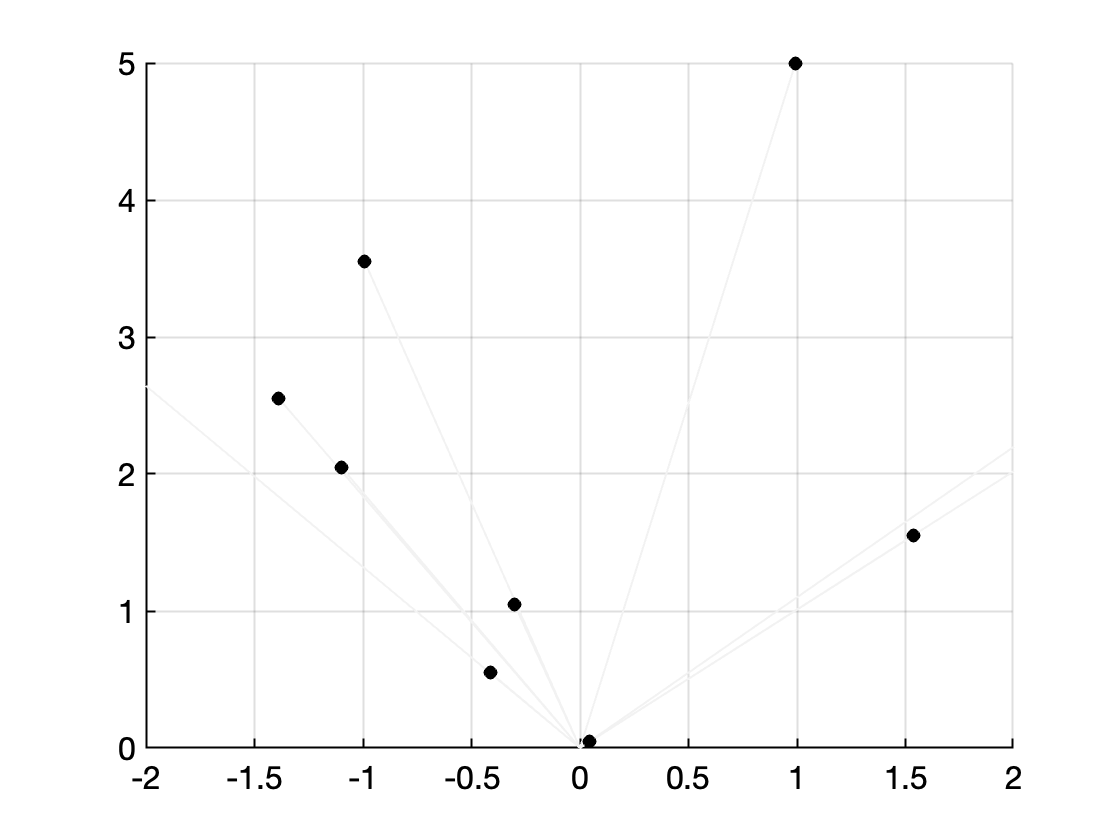
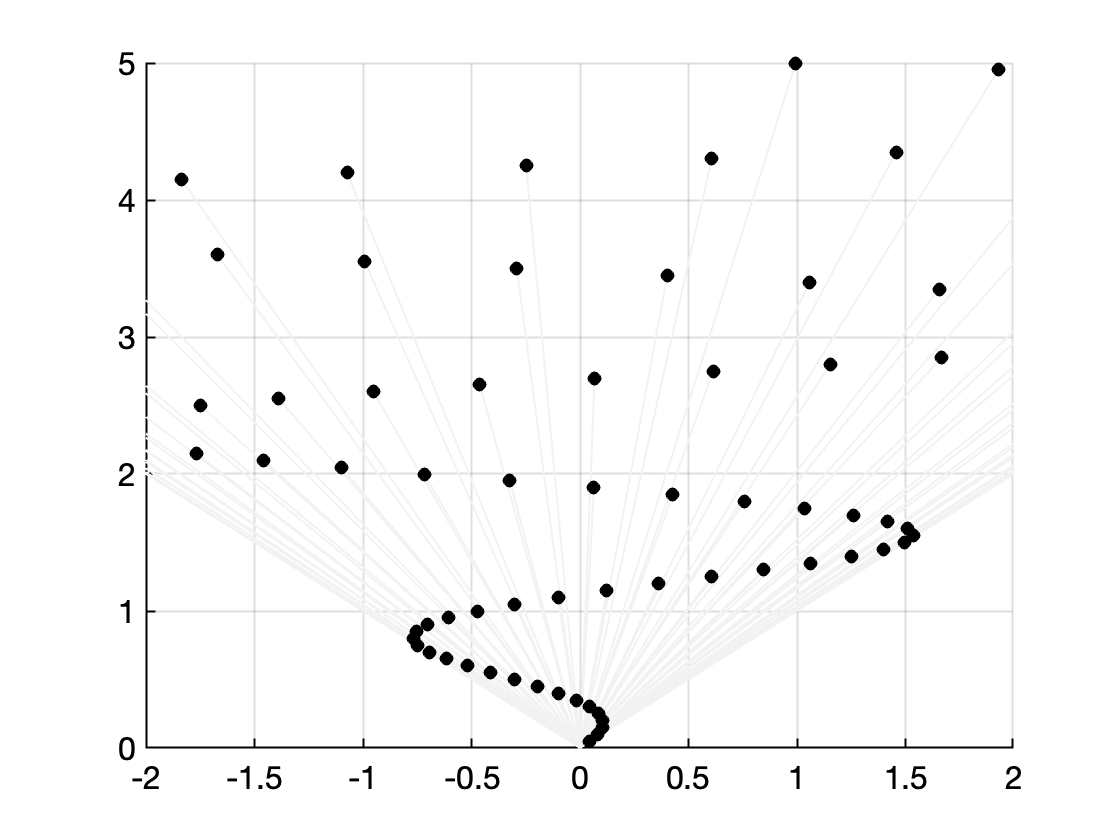
Each particle travels in a straight line. For \(\tau = 0\) this is the \(y\)-axis, \(x = 0\text{;}\) for \(\tau = \pi/(2\omega)\) it is the line \(x =
(u_0/v_0)\,y\) (see Figure 2.7).
Streakline. At time \(t\text{,}\) the streakline through the origin is made up of all particles released there at earlier times \(\tau \le t\text{.}\) Eliminating \(\tau = t
- y/v_0\) from the pathline gives
\begin{equation*}
x = \frac{u_0}{v_0}\, y \sin\big(\omega(t - y/v_0)\big), \qquad y \ge 0.
\end{equation*}
This is a wave travelling in the \(y\)-direction at speed \(v_0\text{,}\) with amplitude growing linearly with distance from the hose (see Figure 2.8). Unlike the streamlines and pathlines, it is the oscillating pattern you actually see in the water jet.
Before we go on, we remind the reader of two important quantities that will be used in the following chapters. These are typically introduced in the prior modules on vector calculus.
The first is the notion of flux through a surface. Given a surface \(S\) and a velocity field \(\bu\text{,}\) the flux through the surface is the amount of flow through the surface per unit time. It is given by the integral
In the two above formulae, refer to your previous vector calculus notes for the procedures to calculate the area element \(\de{S}\) or the line element \(\de{s}\text{.}\)
Finally, we may like to also calculate the total force on a surface or on a contour. If \(\bF\) is the pointwise force applied at every point, the total force is given by
Consider the velocity field \(\bu = (x+y^2,\, 0,\, 0)\text{.}\) Let \(S\) be the flat rectangular surface lying in the plane \(x=2\text{,}\) with \(0\le y\le 1\) and \(0\le z\le 3\text{,}\) oriented with outward unit normal \(\bn = (1,0,0)\text{.}\) Calculate the flux of \(\bu\) through \(S\text{.}\)
Notice that only the \(x\)-component of \(\bu\) contributes, since \(\bn\) points purely in the \(x\)-direction; the flux measures how much fluid crosses \(S\) per unit time in that direction.
Consider the uniform velocity field \(\bu = (2,1)\text{.}\) Let \(C\) be the straight line segment from \((0,0)\) to \((3,4)\text{.}\) Calculate the flux of \(\bu\) through \(C\text{,}\) taking the normal to point away from the origin.
The segment has length \(5\) (a 3-4-5 triangle), and a unit tangent vector along \(C\) is \(\bt = (3,4)/5\text{.}\) Rotating \(\bt\) by \(90^\circ\) so that the resulting normal points away from the origin gives
The main subtlety here is orientation: rotating the tangent the other way would have given \(\bn=(-4,3)/5\) and a flux of \(-5\text{,}\) correctly describing flow in the opposite sense across \(C\text{.}\)
Suppose a pointwise force \(\bF = (x,\, y^2,\, 3)\) acts over the flat rectangular surface \(S\) given by \(0\le x\le 2\text{,}\)\(0\le y\le 1\text{,}\) in the plane \(z=0\text{.}\) Calculate the total force on \(S\text{.}\)
Since \(S\) lies in the plane \(z=0\text{,}\) the area element is simply \(\de{S}=\de{x}\,\de{y}\text{,}\) and no normal vector is needed because \(\bF\) is not dotted with anything in (2.2.3). We integrate each component of \(\bF\) separately: