Section 4.6 Circle maps

In Section 4.4, we used the method of images to construct flows bounded by straight walls, and in Section 4.5 conformal maps extended this to wedges and channels. Many problems of interest instead involve flow past a body. In this section, we consider the simplest such body, a circular cylinder. Milne-Thomson’s Circle Theorem provides the image system for a circle, much as the method of images does for a plane wall, and immediately gives uniform flow past a cylinder. We then add a line vortex inside the cylinder, which shifts the stagnation points and leads to the Magnus effect.

Proof.

(i) If \(|z| > a\text{,}\) then \(|a^2/\overline{z}| < a\text{.}\) Therefore the argument of the second term of \(w\) is within the circle of radius \(a\text{,}\) and by assumption \(f\) is not singular there. The second term is also analytic in \(z\text{,}\) since the two conjugations cancel.
(ii) On the circle itself, \(z = a\e^{\im\theta}\text{.}\) Then \(a^2/\overline{z} = a\e^{\im\theta} = z\text{.}\) Therefore, we have
\begin{equation*} w(z) = f(z) + \overline{f(z)} = 2 \Re[f(z)]. \end{equation*}
Therefore the complex potential is entirely real. It follows that \(\Im w = 0\) on \(|z| = a\text{,}\) establishing that the circle is a streamline.
The above theorem then allows us to easily construct certain flows past circular cylinders. Here is an example.

Example 4.6.2 Uniform flow past a circular cylinder.

Use the Circle Theorem to find the complex potential for uniform horizontal flow of speed \(U\) past a circular cylinder of radius \(a\text{,}\) centred at the origin.
Solution.
We begin with the complex potential \(f(z) = Uz\text{,}\) which corresponds to horizontal uniform flow. It is non-singular for all finite \(z\text{,}\) so it satisfies the requirements of the Circle Theorem. Hence
\begin{equation} w(z) = \phi + \im \psi = Uz + \overline{\frac{Ua^2}{\overline{z}}} = Uz + \frac{Ua^2}{z}.\tag{4.6.2} \end{equation}
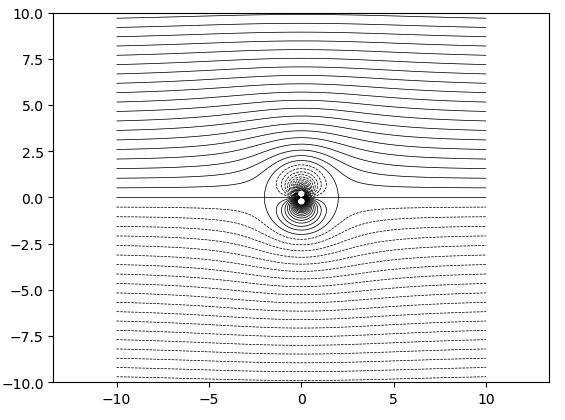
The streamlines of the flow, found by taking the imaginary part of the above, are shown in Figure 4.17.
Circle flow
Figure 4.17. Uniform flow past a circle

Example 4.6.3 Uniform flow past a cylinder with circulation.

Consider the flow of Example 4.6.2, with complex potential
\begin{equation} w(z) = Uz + \frac{Ua^2}{z}.\tag{4.6.3} \end{equation}

(a)

Confirm, by use of the streamfunction \(\psi\text{,}\) that the circle boundary is a streamline of the flow.
It will be useful to remind yourself that
\begin{equation} \cos\theta = \frac{\e^{\im\theta} + \e^{-\im\theta}}{2}. \tag{4.6.4} \end{equation}
Solution.
We set \(z = a\e^{\im\theta}\) into the complex potential. This gives
\begin{equation*} \phi + \im \psi = U a \left( \e^{\im \theta} + \e^{-\im\theta}\right) = 2Ua\cos\theta. \end{equation*}
Therefore \(\psi = \Im w = 0\) on the surface of the cylinder.

(b)

Derive the complex velocity, \(u - \im v\text{,}\) and use it to show that on the surface of the cylinder, the velocity is given by
\begin{equation*} u - \im v = 2U \e^{\im (\pi/2 - \theta)} \sin\theta, \end{equation*}
where \(z = a\e^{\im\theta}\text{.}\)
It is helpful for you to remember that
\begin{equation} \sin\theta = \frac{\e^{\im\theta} - \e^{-\im\theta}}{2\im}.\tag{4.6.5} \end{equation}
Solution.
Differentiating gives the complex velocity,
\begin{equation*} w'(z) = u - \im v = U\left(1 - \frac{a^2}{z^2}\right). \end{equation*}
Substituting \(z = a\e^{\im\theta}\) and simplifying gives
\begin{equation*} u - \im v = U \e^{-\im \theta}\left( \e^{\im\theta} - \e^{-\im\theta}\right) = 2U \e^{\im(\pi/2 - \theta)} \sin\theta. \end{equation*}

(c)

Conclude that on the surface of the cylinder, the maximum velocity is \(|\bu| = 2U\text{.}\) Where does this maximum velocity occur? Where do stagnation points in the flow (where the velocity is zero) occur?
Solution.
From the above, the magnitude is \(|u - \im v| = 2U|\sin\theta|\text{,}\) so the maximum speed on the cylinder is \(2U\text{.}\) This value is obtained at the top and bottom, \(\theta = \pm \pi/2\text{.}\) The stagnation points are where the speed is zero, at the fore and aft points, \(\theta = \pi\) and \(\theta = 0\text{.}\)

(d)

Show that on the surface of the cylinder, the pressure is given by
\begin{equation*} p = p_\infty + \frac{1}{2} \rho U^2(1 - 4\sin^2\theta), \end{equation*}
where \(p_\infty\) is the pressure at infinity.
Solution.
From Bernoulli’s equation (Theorem 3.5.8), without gravity,
\begin{equation*} \left(p + \frac{\rho}{2} |\bu|^2\right)_{\text{cylinder}} = \left(p_\infty + \frac{\rho}{2} U^2\right)_{\text{infinity}}, \end{equation*}
where \(p_\infty\) is the pressure at infinity. Substituting the speed on the cylinder, \(|\bu|^2 = 4U^2\sin^2\theta\text{,}\) gives
\begin{equation*} p = p_\infty + \frac{\rho}{2}U^2(1 - 4\sin^2\theta) \end{equation*}
as desired.

(e)

It is possible to add a line vortex to the interior of the circular cylinder, centred at \(z = 0\text{,}\) by adding to (4.6.3) an additional term:
\begin{equation*} w(z) = U \left(z + \frac{a^2}{z}\right) - \frac{\im\Gamma}{2\pi} \log z. \end{equation*}
Verify again that the above modification does not change the streamline properties of \(|z| = a\text{.}\)
Does the above flow satisfy the condition that the flow is of uniform speed \(U\) far upstream?
Solution.
The streamfunction of the vortex is constant on circles centred at the origin, so the cylinder remains a streamline. Indeed, on the surface, the added term is
\begin{equation*} -\frac{\im \Gamma}{2\pi} (\log a + \im \theta) = \frac{\Gamma\theta}{2\pi} - \frac{\im\Gamma}{2\pi}\log a. \end{equation*}
Therefore the imaginary part is still a constant, and hence the boundary of the cylinder is still a streamline of the flow.
To verify that the upstream flow is not altered, we take a derivative to obtain the complex velocity:
\begin{equation*} w'(z) = u - \im v = U\left(1 - \frac{a^2}{z^2}\right) - \frac{\im\Gamma}{2\pi z}. \end{equation*}
So in the limit \(|z| \to \infty\text{,}\) the velocity is horizontal with speed \(U\text{.}\)

(f)

By studying the velocity of the flow with the vortex added, verify that the complex velocity on the surface is given by
\begin{equation*} u - \im v = \im \e^{-\im\theta}\left(2U \sin\theta - \frac{\Gamma}{2\pi a}\right). \end{equation*}
Conclude that a point on the cylinder that satisfies the equation
\begin{equation*} \sin\theta = \frac{\Gamma}{4\pi a U}, \end{equation*}
is a stagnation point of the flow.
Solution.
Using the previous task and adding the vortex term,
\begin{equation*} u - \im v = 2U \im \e^{-\im\theta}\sin\theta - \frac{\Gamma\im}{2\pi a} \e^{-\im\theta} = \im \e^{-\im\theta} \left(2U \sin\theta - \frac{\Gamma}{2\pi a}\right). \end{equation*}
A stagnation point requires that \(|u - \im v| = 0\text{,}\) so setting the terms in brackets to zero implies
\begin{equation*} \sin\theta = \frac{\Gamma}{4\pi a U}, \end{equation*}
as desired. This requires \(|\Gamma| \le 4\pi aU\text{;}\) for larger \(|\Gamma|\text{,}\) the stagnation point leaves the cylinder.

(g)

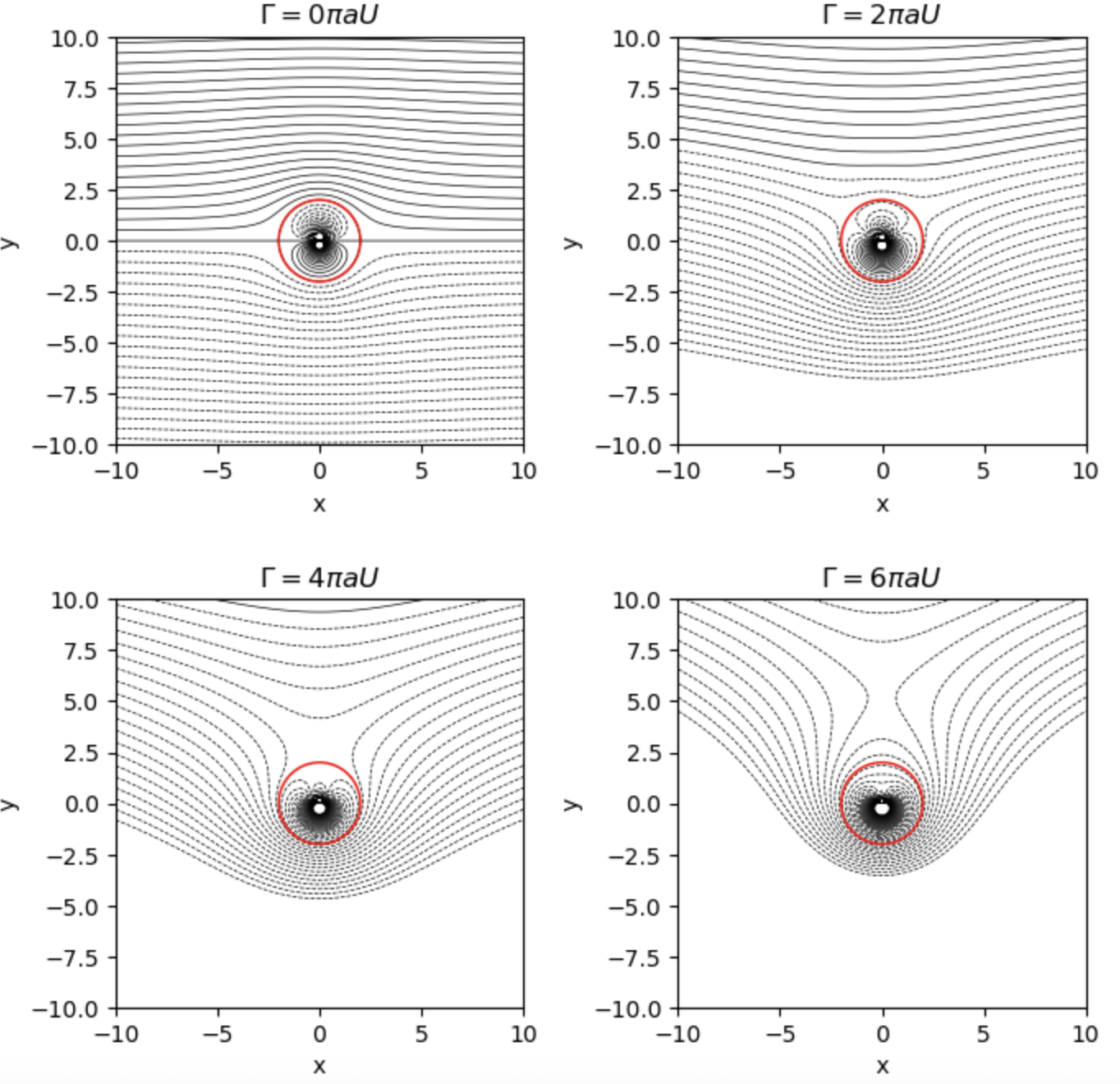
(Not examinable) Use a computational tool to investigate the streamlines of the flow for \(\Gamma = 0\text{,}\) \(2\pi aU\text{,}\) \(4\pi a U\text{,}\) and \(6\pi a U\text{.}\)
The fact that the stagnation point shifts, moving on the top or bottom of the circular cylinder, depending on the value of \(\Gamma\text{,}\) will result in an asymmetry in the pressure, causing a net force on one side of the cylinder. This is related to the well-known Magnus effect, which is used by athletes to make a ball’s path curve.
Solution.
The point of this task is to note that when \(\Gamma \neq 0\text{,}\) the location of the stagnation point shifts. For example, if \(\Gamma = 4\pi a U\text{,}\) then the stagnation points are found at
\begin{equation*} \sin\theta = 1 \Longrightarrow \theta = \pi/2, \end{equation*}
i.e. the top of the cylinder. For \(\Gamma = 6\pi aU\text{,}\) the stagnation point lies off the cylinder.
Flow past a circular cylinder with vortex
Figure 4.18. Flow past a circular cylinder with interior line vortex of different strengths.

Remark 4.6.4 Mapping the circle to an aerofoil.

In classical teaching of potential flow theory, one would also show how the circle can be conformally mapped to an aerofoil-like shape, including a flat plate, for example using the Joukowski map. The flows past a circular cylinder constructed in this section then give the flow past the aerofoil.

Aside: Removed in 2026.